
Getting your WordPress site to the top of Google is about getting the basics right first. It all comes down to a blend of a rock-solid technical setup, smart content, and building genuine authority. The starting line for any serious SEO effort is making sure your website is fast, secure, and easy for Google to understand.
Building Your Foundation for Higher Rankings
Before you even think about complex link-building campaigns or advanced content strategies, you need to look at your site's foundations. I always tell clients to think of their website like a house. You wouldn't put on a new roof if the walls were crumbling, right? The same logic applies here. Technical excellence is your foundation.
A slow, clunky, or insecure website is an instant turn-off for visitors and a major red flag for Google. This is doubly true if you're a UK business trying to attract a local audience. Choosing a hosting provider with servers physically located in the UK gives you an immediate speed advantage, cutting down on lag time for your customers.
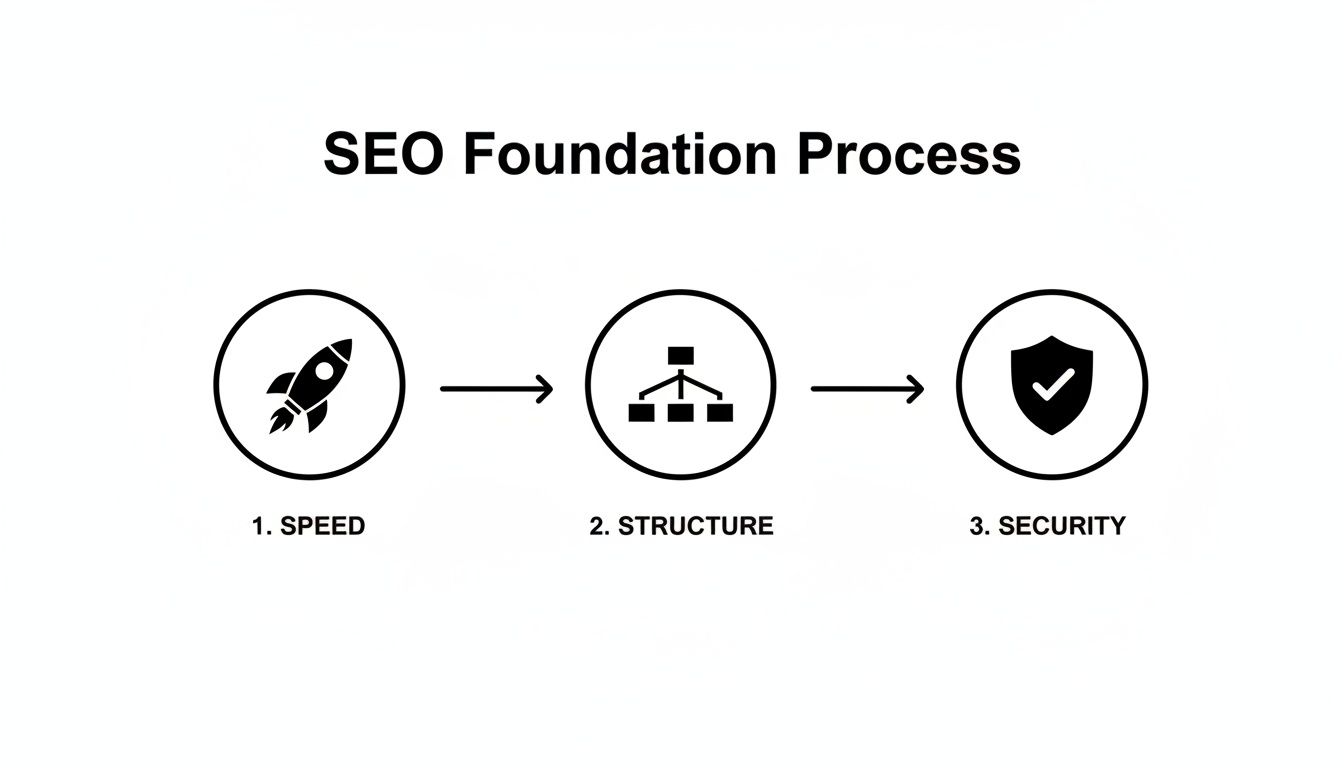
Speed, Structure, and Security
When I talk about technical foundations, I'm really drilling down into three core pillars. Get these right, and you're well on your way.
- Speed: Your site needs to load in a snap. People have zero patience for slow websites, and a high bounce rate tells Google your site isn't delivering a good experience.
- Structure: Your website needs a logical layout and a clean XML sitemap. This is like giving Google's crawlers a clear, easy-to-follow map of your most important pages.
- Security: Using an SSL certificate (HTTPS) is an absolute must. It's not just about that little padlock in the browser; it protects your users' data and is a confirmed, if minor, ranking signal.
This process is a continuous loop. You build a fast, secure, and well-structured site, which forms the bedrock for everything else you do in SEO.
Nailing these three elements makes your site accessible to Google and enjoyable for your visitors—a win-win.
Why Technical Excellence Matters
Focusing on site speed and technical health is one of the most effective things UK WordPress site owners can do. Search engines are designed to reward websites that users love, and users love fast, mobile-friendly experiences.
Consider this: organic traffic drives nearly 47% of all website visits, but the real prize is at the very top. The first result on Google gets a staggering 39.8% of all clicks. That number plummets for every position below it. A good managed hosting plan with features like advanced caching can dramatically speed up your site, which directly helps with Google's Core Web Vitals and gives your rankings a real boost.
A technically sound website isn't just about playing to the algorithm. It's about showing respect for your users' time and earning their trust. A fast, secure, and well-organised site is the ultimate sign of a professional business and a non-negotiable for ranking higher.
Getting these fundamentals sorted is the first, most critical step. For a more detailed breakdown, this guide on improving search engine rankings offers some excellent strategies. And if you’d rather have an expert handle it, our dedicated website optimisation service is designed to get your technical SEO into fighting shape.
Mastering Keywords and On-Page Optimisation
Now that your site’s technical foundations are solid, we can get into the good stuff: the words your customers actually use to find you. Proper keyword research isn’t about chasing obscure terms; it’s about getting inside your audience’s head and understanding what they’re genuinely searching for. This is where you connect your content directly to their needs, and it’s a massive part of climbing the search rankings.
Forget just plastering your pages with generic phrases. The real game is decoding user intent. Think about it: is someone searching for "best coffee beans UK" looking to buy a subscription, find a local roaster, or just read a blog post? Each of those is a different person with a different goal.
Uncovering Keywords That Actually Convert
Let's start by thinking about the problems you solve for people. If you're a plumber in Manchester, trying to rank for "plumber" is a fool's errand. It's far too broad and competitive. What you really want are the specific, high-intent phrases that signal someone needs help right now.
-
Commercial Intent Keywords: These are the money-makers. They usually include words like "buy," "quote," "service," or "near me." A search for "emergency boiler repair Manchester," for instance, shows a user who’s got their credit card out, ready to hire.
-
Local Intent Keywords: For any UK business, tying your service to a location is vital. Think along the lines of "WordPress support London," "artisan bakery Bristol," or "WooCommerce developer Cardiff." You're catching people who are actively looking for local expertise.
-
Informational Keywords: These are your trust-builders. A keyword like "how to fix a leaking tap" might not land you a job today. But by providing a genuinely helpful answer, you become the expert they remember and the first person they call when a bigger problem hits.
Building a modern SEO keywords strategy is all about creating a map of your customer’s journey, told through their search queries.
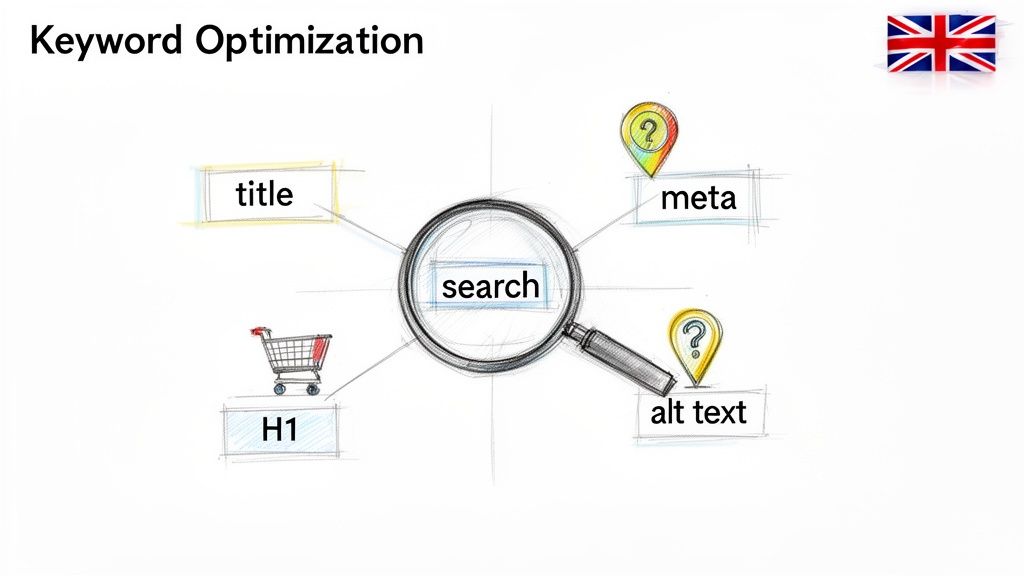
Putting Your Keywords in All the Right Places
Once you’ve got your target keywords, you need to weave them into your pages where they’ll have the most impact—without sounding like a robot. Search engines are incredibly sophisticated now and reward content written for humans. Luckily, WordPress makes it easy to edit these crucial on-page elements.
| On-Page Element | Why It Matters for SEO Rankings | Practical Example (for a UK Pet Shop) |
|---|---|---|
| Title Tag | This is the blue link people see in Google’s results. It’s a huge ranking signal and needs to be compelling while including your main keyword. | Hypoallergenic Dog Food UK | Natural Pet Supplies Store |
| Meta Description | Not a direct ranking factor, but a great description acts as your sales pitch, massively boosting the chances someone clicks on your link. | Discover our range of natural, grain-free hypoallergenic dog food. Fast, free delivery across the UK for all orders over £40. |
| H1 Heading | The main title on the page itself. You should only ever have one, and it needs to clearly state the page's purpose and feature the keyword. | The Best Hypoallergenic Dog Food in the UK |
| Image Alt Text | This describes images for search engines and visually impaired users. It’s a perfect, natural spot to include relevant keywords. | A golden retriever eating from a bowl of natural hypoallergenic dog food. |
Optimising these elements is a balancing act. The goal is always to create content that flows naturally for a real person while sending clear, unambiguous signals to Google about what your page is about. A well-optimised page doesn't just rank; it gets clicks and keeps people engaged. If you're noticing visitors are leaving your site almost immediately, take a look at our guide on how to reduce website bounce rate for some practical advice.
Remember, the ultimate goal of on-page optimisation is to create the single most helpful, relevant, and clear answer for a user's query. When you achieve that, you've won more than half the battle for better search rankings.
By aligning your keywords with real user intent and strategically placing them on your pages, you create something that both your audience and search engines will love. This methodical approach is the beating heart of any effective SEO strategy.
Creating Content That Google's E-E-A-T Loves
Once your WordPress site is technically sound and you've got a solid keyword strategy, it’s time to focus on the real heart of SEO: your content. This is why people come to your site in the first place, and it’s your main way of proving your worth to Google. But let's be clear, not all content is created equal.
If you want to make a real dent in your rankings, you need to create content that aligns with Google's quality guidelines. They've bundled this philosophy into a neat little acronym: E-E-A-T. This stands for Experience, Expertise, Authoritativeness, and Trustworthiness. Think of it as Google's internal checklist for figuring out if your content is genuinely helpful, reliable, and written by someone who actually knows their stuff.
This framework is absolutely vital for what Google calls "Your Money or Your Life" (YMYL) topics. We're talking about things like financial advice, health information, and yes, even e-commerce. For a WooCommerce store, every product page and every bit of advice you offer is under intense scrutiny.
Demonstrating Real-World Experience
The first 'E'—Experience—is a relatively new addition, but it's a total game-changer. Google is tired of generic, rehashed content. It wants to see that your articles and guides come from someone with first-hand, practical knowledge. It's all about showing you've actually done the thing you're writing about.
For instance, if you sell high-performance running shoes, a blog post titled "Our Top 5 Running Shoes" is okay, but it's a bit generic. A post titled "We Ran 100km in Five Different Running Shoes and Here’s What We Learned"? That demonstrates genuine, hard-won experience.
Here’s how to start injecting real experience into your content:
- Create detailed case studies: Show the before-and-after of using your product. Use real data, real photos, and real testimonials.
- Write in the first person: Don't be afraid to use "I" and "we." Share personal insights and behind-the-scenes stories that only you could tell.
- Use original photos and videos: Ditch the stock images. Show your actual products being used by real people, or give a glimpse of your team at work.
This approach builds a genuine connection. It feels authentic and proves you aren't just another site rehashing the same old information.
Showcasing Your Expertise and Authority
Expertise and Authoritativeness go hand-in-hand. Expertise is about having a high level of skill or knowledge in your field. Authority is about being recognised as a leader in that field. You've got to prove both.
A simple but powerful place to start is with detailed author biographies. Don't just slap a name at the top of a post. Explain who the author is, what their qualifications are, and why they’re the right person to be talking about this topic. Link out to their professional profiles or other articles they've written. This tells both Google and your readers that the content is coming from a credible source.
Another great tactic is to build authority through collaboration. Team up with other recognised experts or organisations in the UK. This could be a joint webinar, a co-authored whitepaper, or even just quoting an industry leader in your blog post and letting them know about it. These kinds of associations act as a powerful vote of confidence in your brand.
E-E-A-T isn't just a box-ticking exercise for Google. It's a framework for building a brand that customers genuinely trust and want to buy from. When you prove your experience and authority, you're not just improving your SEO rankings; you're building a loyal audience.
Building Unbreakable Trust
The final letter, 'T' for Trustworthiness, is probably the most important of all, especially for any WordPress site running WooCommerce. Trust is the bedrock of every single transaction. If a user doesn't trust your website, they simply will not enter their card details, no matter how amazing your products are.
Here are a few practical ways to build that trust:
- Be Transparent: Make your contact information, including a physical UK address and phone number, incredibly easy to find. Have crystal-clear privacy policies, terms of service, and return policies.
- Display Social Proof: Show off your customer reviews and testimonials. Using a recognised third-party review platform adds an extra layer of credibility that you just can't fake.
- Guarantee Security: Your SSL certificate is the bare minimum. Go further by displaying security badges from trusted payment gateways (like Stripe or PayPal) throughout the checkout process. This reassures customers that their financial data is in safe hands.
For an e-commerce site, trust is directly tied to your bottom line. Every little thing, from product descriptions that are accurate and honest to a secure, frictionless checkout, adds to your site’s trustworthiness. By weaving these E-E-A-T principles into your content, you create a powerful cycle: you provide better value for users, which builds trust, which encourages sales, and which sends all the right signals to Google to boost your SEO rankings.
Winning the Local SEO Battle in the UK
For most UK businesses, the real digital battle is won on local ground. While aiming for national visibility is a fine long-term goal, the customers who actually pay your bills are often just around the corner. Nailing local search isn't just a vanity project; it's how you turn people searching on their phones into real footfall and revenue.
Let's dive into how you become the obvious local choice.
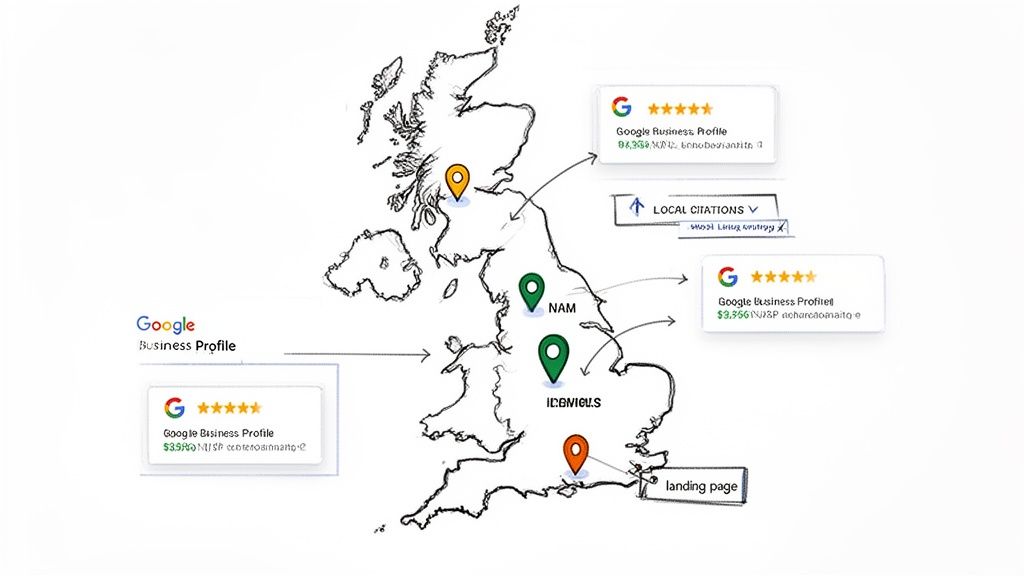
Your Most Powerful Weapon: Google Business Profile
Think of your Google Business Profile (GBP) as your most powerful weapon in this fight. It's not just another listing; it's a dynamic mini-website that lives right inside Google's search results. An incomplete or neglected profile is like having a shop with a dusty, uninviting window display. You have to treat it with the attention it deserves.
This means filling out every single section. Add your services, products, accurate opening hours, and plenty of high-quality photos of your premises, your team, and your work in action. Use the Q&A feature proactively—don't wait for questions to roll in. Seed it yourself with common queries and provide clear, helpful answers. A fully fleshed-out GBP sends powerful signals to Google that you're an active, legitimate, and highly relevant local business.
Building Local Trust Through Consistency
Beyond your GBP, Google looks for consistent information across the web to verify who you are and where you operate. This is where your NAP (Name, Address, Phone number) details become critical. Your NAP must be absolutely identical everywhere it appears online, from your website’s footer to every single business directory.
Each consistent listing, or citation, acts as a small vote of confidence for your business. Inconsistencies, even something as minor as using "Ltd" in one place and "Limited" in another, can confuse search engines and water down your local authority.
- Audit Your Existing Citations: Use a tool to find where your business is listed online and methodically correct any errors you find.
- Build New, Relevant Citations: Get listed in reputable UK-based directories that make sense for your industry, such as Yell, Thomson Local, or niche-specific sites.
- Encourage Customer Reviews: Positive reviews on your GBP are a massive local ranking factor. Don't be shy about asking happy customers to leave feedback. And always, always respond professionally to every review, both good and bad.
This careful work builds a web of trust signals that cements your connection to a specific geographic area in Google's eyes.
To help you stay on track, here's a quick checklist of the most important local SEO tasks. Focusing on these actions will give you the biggest bang for your buck when trying to rank in your local area.
Local SEO Priority Checklist for UK Businesses
| Action Item | Why It's Critical | Example Tactic |
|---|---|---|
| Optimise Google Business Profile | This is your digital storefront. It's often the first interaction a local customer has with your brand on Google. | Fully complete all sections, upload 10+ high-quality photos, and use the Q&A feature to answer common questions proactively. |
| Standardise NAP Information | Inconsistent details confuse Google and erode trust, directly harming your chances of appearing in the local map pack. | Decide on one official version of your name, address, and phone number. Use it everywhere, down to the last comma. |
| Build High-Quality Citations | Citations in reputable directories act as third-party verification of your business, boosting your local authority. | Get listed on Yell, Thomson Local, and at least three industry-specific UK directories. |
| Generate & Respond to Reviews | Reviews are a powerful trust signal for both potential customers and Google's ranking algorithm. | Create a simple email or text message template to ask satisfied customers for a review on your GBP listing. |
| Create Hyper-Local Landing Pages | These pages target high-intent customers searching for a specific service in a specific town or neighbourhood. | If you're a plumber in Leeds, create a page titled "Boiler Repair Services in Headingley" with localised content. |
By systematically working through this list, you're building a solid foundation that proves to Google you are the best result for local searchers.
Creating Hyper-Local Landing Pages
To capture those high-intent local searches, you need to go beyond just optimising your homepage. A hugely effective tactic is creating dedicated landing pages for specific services in specific locations.
For instance, a page titled "WordPress Support in Manchester" is far more likely to rank for that search query than a generic services page. These pages need to feel genuinely local. Mention local landmarks, include a map of your service area, and, most importantly, feature testimonials from local clients. This demonstrates to both users and Google that you are truly part of the local community.
This laser-focused approach sends undeniable signals that you are the premier choice for that service in that area. Combine this with a powerful GBP and consistent citations, and you have a winning formula for local SEO. Of course, a high-performance website is the foundation for all of this, and having your site hosted on UK servers can provide an extra edge. You can learn more about the benefits of our managed WordPress hosting in the UK and see how it supports a strong local online presence.
Building Authority with Quality Backlinks
So, you’ve got a technically solid website and content that’s ticking all of Google’s boxes. What’s next? It's time to build your site's reputation, and in the world of SEO, that means earning backlinks.
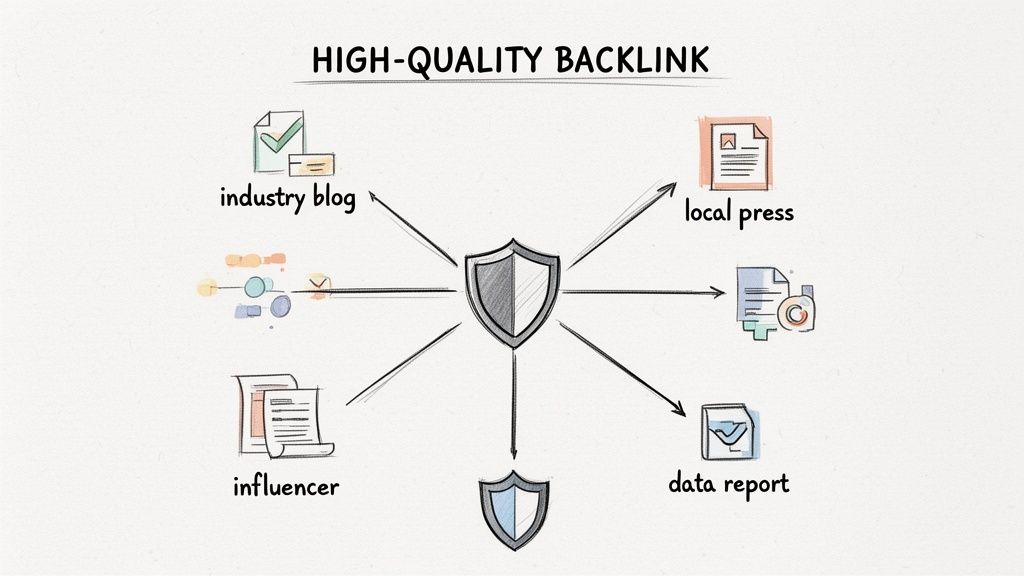
Think of a backlink as a vote of confidence. When another website links to yours, they’re essentially telling Google, "Hey, this content over here is legit and adds value." This is the core of how you build authority and climb the rankings for the long haul.
The game has changed drastically, though. The old days of buying thousands of cheap, spammy links are long gone. Now, it’s all about quality over quantity. A single, relevant link from a well-respected UK industry blog is worth a hundred times more than a pile of links from irrelevant, low-quality sites. The real goal is to earn these links naturally by creating things people actually want to share.
Earn Links, Don't Chase Them
The best, most sustainable way to build a strong backlink profile is by creating what we call "linkable assets." These are pieces of content or tools so genuinely useful that other people in your industry can't help but reference and link to them. This completely flips the script from begging for links to earning them organically.
So what does a linkable asset look like?
- Original Research or Data: Imagine you're a UK marketing agency. You could survey 500 local businesses about their social media habits and publish the findings. That unique data becomes a primary source that other industry blogs will be eager to cite.
- Free Tools or Calculators: A mortgage broker could build a simple "UK Stamp Duty Calculator." It’s practical, provides immediate value, and is incredibly linkable for finance and property websites.
- The Ultimate Guide: Your goal here is to create the single most comprehensive resource on a topic in your niche. For example, a WooCommerce developer could write an exhaustive guide to "Optimising Your UK Store for GDPR."
This isn’t about tricking algorithms. It's about building genuine relationships and establishing yourself as a trusted voice in your field.
Practical Link-Building Tactics for UK Businesses
Creating killer linkable assets is a brilliant long-term play, but you also need to be proactive to get the ball rolling. The trick is to focus your energy on sources that are actually relevant to your UK audience.
Earning a backlink is more than just an SEO tactic; it's a signal that you've created something of real value. When you focus on providing genuine expertise and building real relationships, the links—and the authority that comes with them—will follow naturally.
A tried-and-tested method is guest posting. This is where you write an article for another website in your industry. It’s a classic win-win: they get great content for their audience, and you get a valuable backlink and put your brand in front of new people. Start by looking for well-regarded UK industry blogs or even complementary local businesses and pitch them a topic that their readers will find genuinely useful.
Another powerful approach is to team up with local influencers or organisations. If you run a café in Brighton, partnering with a local food blogger for a review can land you a powerful, geo-relevant backlink. These kinds of partnerships don’t just build your online authority; they cement your place in the local community, sending strong trust signals to Google that you’re a legitimate, respected business.
Measuring What Matters for SEO Success
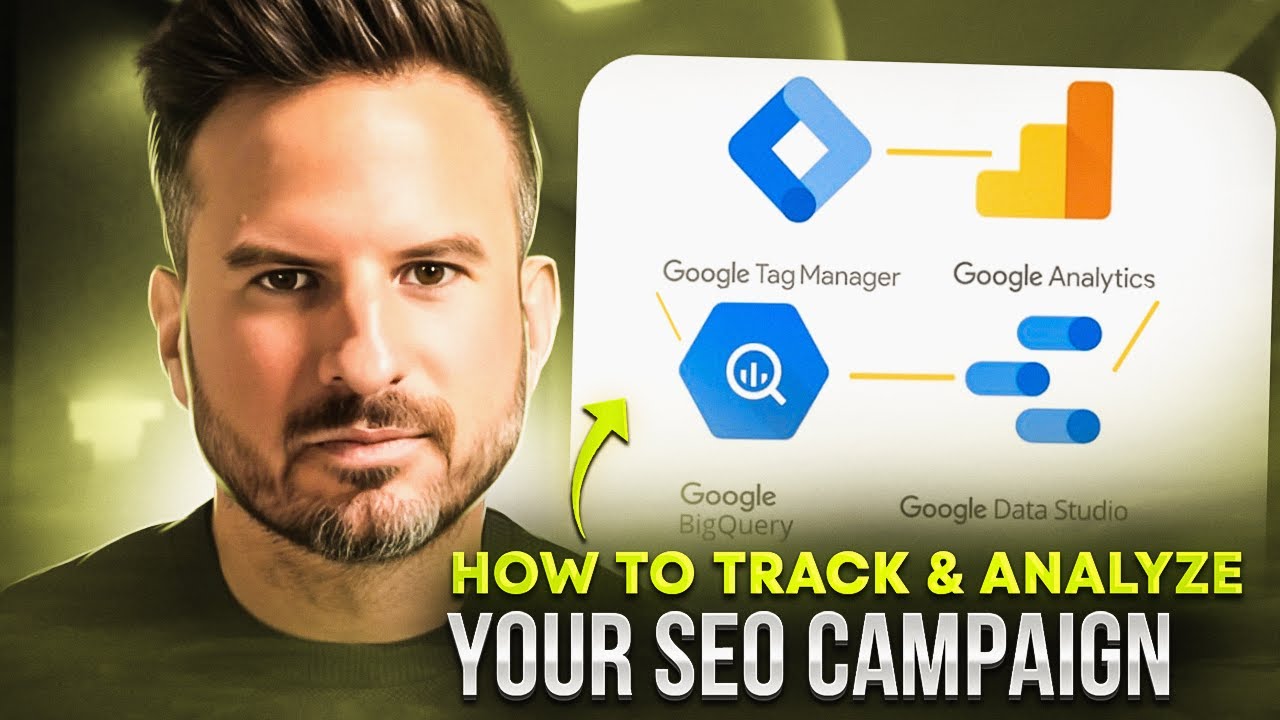
You can’t improve what you don’t measure. Simple as that. After all the technical fixes, content tweaks, and link building, this is where the rubber meets the road. You need to track your progress to see what’s working, what isn’t, and prove your efforts are actually moving the needle.
It's time to look beyond vanity metrics. Obsessing over daily keyword position changes won’t get you very far. Instead, we need to dig into the actionable insights you can get from tools like Google Search Console (GSC) and Google Analytics. These free platforms are basically your command centre for seeing how real people find and use your WordPress site.
Your main job here is to figure out which pages are pulling in valuable traffic and what people do once they land there. Are they sticking around and engaging, or are they hitting the back button straight away? The answers are all in the data.
Key Metrics to Monitor
To get a real sense of your SEO performance, you need to look at a handful of metrics together. They tell a story. Don't get bogged down in an ocean of data; just focus on the numbers that actually connect to your business goals.
Here’s what I always keep a close eye on:
- Organic Clicks and Impressions (GSC): Impressions show you how many times you appeared in search results. Clicks show how many people actually came to your site. A ton of impressions but hardly any clicks? That’s often a sign of a weak page title or meta description that isn't grabbing anyone's attention.
- Click-Through Rate or CTR (GSC): This is just the percentage of impressions that turn into a click. Honestly, improving your CTR is one of the quickest ways to boost traffic without having to move up in the rankings.
- Average Position (GSC): This gives you a general idea of where you rank for different keywords. I love using this to find "striking distance" pages—the ones hovering in positions 11-20. A little content refresh or a few more internal links can often bump them onto page one.
- Top Performing Pages (Analytics): This report is gold. It shows you which pages are your traffic workhorses. Are they the ones you thought they would be? These are your most valuable digital assets; treat them as such.
The real magic happens when you connect the dots between these numbers. A sudden drop in traffic to a key page often lines up with a dip in its average position. That’s your signal to jump in and see what needs fixing—fast.
Iterative Testing and Improvement
One of the most powerful things you can do to improve SEO rankings is to constantly run small tests. A classic example is A/B testing your page titles directly in Google Search Console.
Find a page with high impressions but a poor CTR. Tweak the title to be more benefit-focused or maybe add a compelling number. Let it run for a couple of weeks, then compare its CTR to the two weeks prior. This simple, iterative process lets you make decisions based on real data, and those small wins really add up.
The game is always changing, too. Just tracking keyword positions is an old-school approach. A much smarter way is to measure your overall organic visibility across a whole bucket of important queries. For Vivihosting clients, building authority on solid UK infrastructure is critical, especially when you realise that over 97% of pages get zero traffic from Google.
With things like AI Overviews shaking up the search results, tracking your visibility across different types of queries is the only way to prove your commercial impact. It’s worth reading up on these evolving UK SEO metrics to stay on top of your game. This cycle of measuring, testing, and refining is what separates good SEO from great SEO.
Your Top SEO Questions Answered
When you're trying to figure out how to improve SEO rankings, it's easy to get bogged down. Let's clear up some of the most common questions UK business owners have when they start this journey.
How Long Until I Actually See SEO Results?
This is the big one, isn't it? The honest answer is that SEO is a marathon, not a sprint. While you might see a small uptick from technical fixes within a few weeks, meaningful results—think significant traffic and ranking improvements—typically take four to 12 months to materialise.
A lot depends on how competitive your industry is, the history of your website, and how consistently you put in the work. The real key is to aim for steady, sustainable growth. Build a solid foundation with quality content and a great user experience, and have patience. It's probably the most valuable asset you have in the SEO game.
Should I Focus on On-Page or Off-Page SEO?
It's a classic question, but it’s not really an either/or situation. They’re two sides of the same coin, and one is pretty useless without the other.
I always tell people to think of it like this:
- On-page SEO is your foundation. This is all the stuff you control directly: your content, keyword optimisation, and site structure. Get this wrong, and your off-page efforts will fall flat.
- Off-page SEO builds your authority and reputation. This is about earning backlinks from other respected sites and getting your brand mentioned. It’s what signals to Google that your well-optimised content is also trustworthy.
The takeaway? Get your on-page house in order first. Once that's solid, you can start building authority with a smart off-page strategy.
My advice is always to prioritise a technically sound, well-optimised website first. It makes every single backlink you earn later on so much more powerful, giving you the best possible return on your effort.
How Much Does My Website Hosting Really Affect SEO?
More than you might think. Your hosting is a crucial, and frankly, often overlooked factor in SEO. It has a direct impact on site speed, security, and uptime—all things Google pays very close attention to. A slow, flaky website creates a terrible user experience, and Google will penalise you for it.
For any UK business, choosing a host with UK-based servers is a no-brainer. It gives you an immediate advantage in local search, sending a strong signal to Google that you're relevant to a local audience. It’s a simple way to help you connect with customers right on your doorstep.
At Vivihosting, we live and breathe this stuff. We provide performance-focused, UK-based infrastructure with hands-on management to keep your site fast, secure, and climbing the search rankings. Learn more at https://vivihosting.com.