


Think of a website optimisation service as a full-service pit crew for your online presence. It’s the professional tune-up that takes your website from a sluggish, clunky machine and turns it into a high-performance engine for your business. The entire process is laser-focused on making your site faster, safer, and better at turning casual visitors into loyal customers.
So, What Exactly Is a Website Optimisation Service?
Let's use a real-world analogy. Imagine your website is your flagship retail store. If the doors are hard to open, the layout is confusing, and the queue at the till stretches out the door, people are going to leave—fast. A website optimisation service is like bringing in a top-tier retail consultant who meticulously fixes every single one of those problems for your digital shop.
This goes far beyond a few technical tweaks; it's a core investment in your business's health. The aim is to create a smooth, enjoyable experience that makes it incredibly easy for people to go from just browsing to hitting that 'buy now' button. A slow or frustrating site doesn't just annoy potential customers; it actively pushes them towards your competitors and tarnishes your brand's reputation.
The Four Pillars of a Well-Tuned Website
A truly effective website optimisation service stands on four essential pillars. They all work together, and if one is weak, the whole structure suffers.
- Blistering Speed: In the online world, every millisecond counts. Your site needs to feel instantaneous. Modern users have almost zero patience for lag, and a slow-loading page is a guaranteed way to lose a sale. Speed isn't a luxury; it's a direct driver of customer satisfaction and conversions.
- Rock-Solid Security: Your visitors have to feel safe. A secure, well-protected website builds the trust needed for them to hand over their personal details and payment information. For any business, especially e-commerce stores, this is completely non-negotiable.
- Effortless User Experience (UX): Can people find what they’re looking for without thinking? Navigation should be second nature. A great UX means your site is just as easy to use on a mobile phone in a coffee shop as it is on a desktop computer at home.
- A Strong SEO Foundation: If Google can't find you, your customers can't either. Technical optimisation ensures search engines can easily crawl and understand your site's content, which is fundamental to ranking higher and attracting valuable organic traffic.
When you bring these four elements together, your website transforms from a static online brochure into your most powerful tool for growth. It’s about making your site work tirelessly for you, 24/7.
Ultimately, a professional optimisation service takes care of all the complex, behind-the-scenes work that's vital for online success. They'll handle everything from server-level tuning and code clean-ups to image compression and security monitoring. This frees you up to do what you do best—run your business—knowing that your digital storefront is in expert hands, performing flawlessly to attract and convert your ideal customers.
What Goes Into a High-Performing Website?
To really get what a website optimisation service does for you, we need to pop the bonnet and have a look inside. This isn't about flicking a single switch; it’s a whole series of interconnected tune-ups that work together to make your site faster, safer, and much better at turning visitors into customers. Think of it like a Formula 1 car – every single component, no matter how tiny, is fine-tuned for peak performance.
Each one of these components tackles a specific weakness that could be costing you sales, chipping away at your brand's reputation, or simply making you invisible to search engines. Let's break down the essential gears that make your website run like a well-oiled machine.
H3: The Core Components of Website Optimisation
So, what are these "gears"? They range from clever server-side tricks to meticulous code adjustments. Below, we've laid out the core technical services involved in a professional optimisation package and, more importantly, what they actually mean for your business in the real world.
The following table breaks down the key technical actions and connects them to tangible business benefits, making it clear how these behind-the-scenes tweaks translate into real-world results.
| Optimisation Component | Technical Action | Direct Business Benefit |
|---|---|---|
| Performance Tuning & Caching | Creating and serving pre-built, static versions of your pages instead of building them from scratch for every visitor. | Drastically improved loading times (under 2 seconds), leading to lower bounce rates and a much better user experience. |
| Image & Asset Optimisation | Compressing images, using modern formats (like WebP), and "minifying" code files (CSS/JavaScript) to make them smaller. | Faster page loads, especially on mobile devices, which improves SEO rankings and keeps visitors engaged. |
| Server Optimisation | Fine-tuning the server environment where your website lives to ensure it handles requests efficiently. | A stable, reliable website that can handle more traffic without slowing down during busy periods, like a sale. |
| Security Hardening | Proactively closing security gaps with firewalls, regular malware scans, and stronger login protection. | Increased customer trust and protection of your business data, reducing the risk of costly breaches and downtime. |
| Automated Backups | Setting up regular, automatic copies of your entire website, stored securely off-site. | Total peace of mind. If anything goes wrong, your site can be restored quickly, minimising disruption to your business. |
| Basic SEO Guidance | Ensuring the website’s technical foundation is perfectly aligned with Google's best practices. | Improved visibility in search results, leading to more organic traffic and potential customers finding you for free. |
| WooCommerce Tuning | Specifically optimising the database, checkout process, and product filters for e-commerce sites. | A smoother shopping experience, faster checkouts, and fewer abandoned carts, directly boosting your online sales. |
As you can see, it's not just about one thing. A truly optimised website is the sum of all these carefully managed parts, each contributing to a stronger, more profitable online presence.
H3: Let's Break That Down Further
Performance Tuning and Caching
At the heart of any fast website is smart performance tuning, and the most powerful tool here is caching. Think of it this way: every time someone new visits your site, your server has to build the page from scratch. It fetches the text, finds the images, runs the code, and puts it all together. It’s like a chef making a complex meal from scratch for every single customer. It takes time.
Caching is the equivalent of a brilliant meal-prep service. It builds the page once, saves a ready-to-go version, and then serves that perfect copy to visitors instantly. This simple idea slashes the server's workload and gives your visitors that near-instant loading experience they expect. It’s the difference between waiting 20 minutes for a chef and having your meal served the moment you sit down.
The infographic below shows how all these different pillars—speed, security, SEO, and user experience—work together to create a solid foundation for your website.
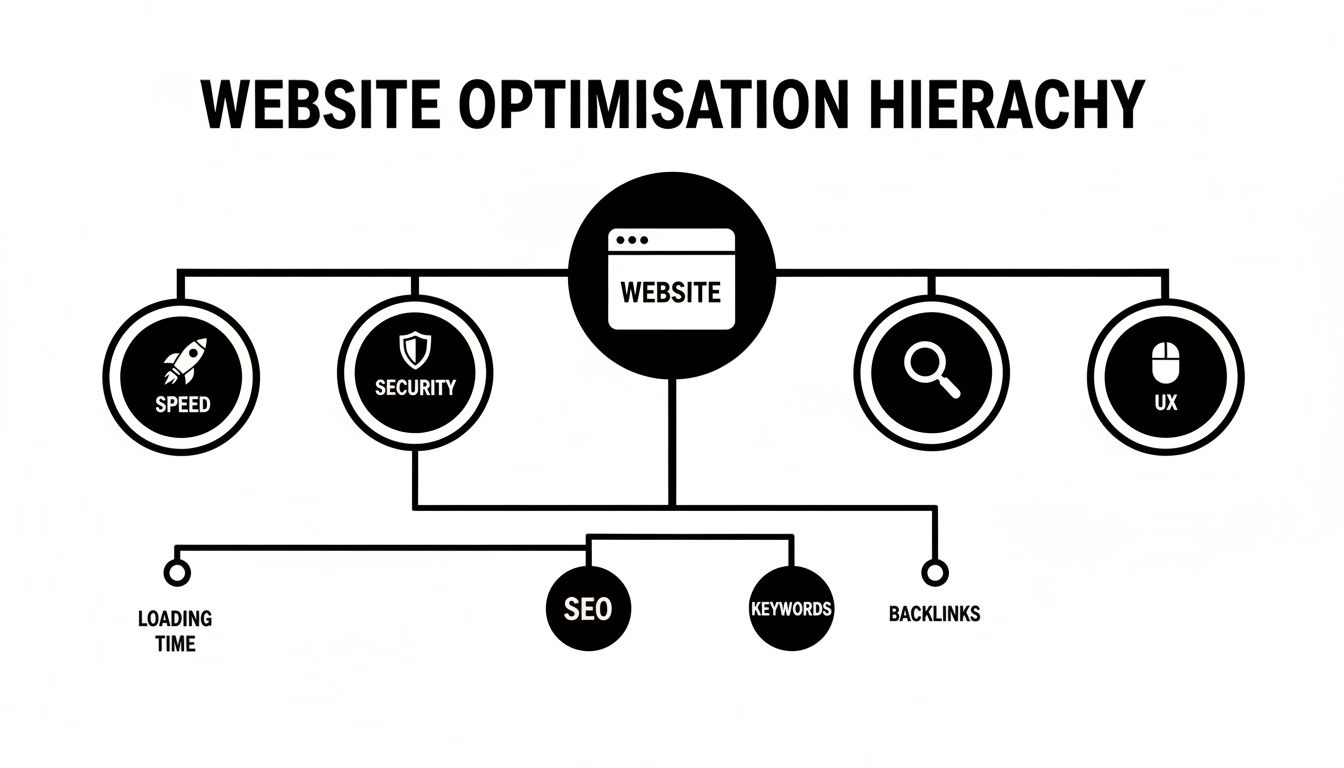
This really drives home the point that a successful site isn't built on just one thing; it relies on the balanced strength of all these elements working in harmony.
Image and Asset Optimisation
More often than not, the biggest culprits behind a slow website are large, clunky images. A professional service will go through your site and systematically fix this. They'll compress images without you ever noticing a drop in quality, convert them to modern, faster formats like WebP, and set up "lazy loading." Lazy loading is a clever trick where images only load when you scroll down to them, instead of trying to load everything at once.
This same idea applies to your site's code files (the CSS and JavaScript). A process called minification strips out all the unnecessary fluff from the code, like spaces and comments, making the files much smaller and quicker to download. Sometimes they'll even combine multiple files into one, which means the browser has fewer things to fetch. It all adds up to a noticeable speed boost.
Security Hardening and Monitoring
A fast website is completely useless if it's not secure. Security hardening is all about proactively finding and locking the doors before a burglar even tries the handle. It's a non-negotiable part of any proper optimisation service.
Here are a few of the key measures a professional will put in place:
- A Web Application Firewall (WAF): This is like having a digital bouncer at the door, checking everyone's ID and turning away dodgy traffic before it gets anywhere near your website.
- Regular Security Scans: Think of this as a constant patrol. Automated tools are always on the lookout for malware, out-of-date plugins, and other potential weak spots.
- Stronger Login Security: This could mean enforcing strong passwords or adding two-factor authentication to stop hackers from simply guessing their way in.
- Limiting Login Attempts: A simple but effective way to stop "brute-force" attacks, where bots just sit there trying thousands of password combinations.
Taking these steps builds huge trust with your customers. People are far more willing to hand over their details and make a purchase on a site they feel is properly protected.
Backups and SEO Guidance
Peace of mind is a seriously underrated business asset. Having automated, regular backups means that if the worst should happen – whether it's a server crash or a security breach – your website can be rolled back to a safe version in minutes. Any good service will store these backups somewhere secure and completely separate from your website itself.
Finally, you can't separate technical optimisation from good SEO. The two go hand-in-hand. A fast, secure, and mobile-friendly website is exactly what search engines like Google are looking for. An optimisation service gives you crucial on-page SEO guidance, making sure your site’s structure and technical setup are hitting all the right notes. This helps search engines understand your site better, which directly contributes to higher rankings and more organic traffic over time.
While this overlaps with ongoing care, it’s a core part of the initial optimisation process. To see how this fits into a bigger picture, you can learn about the comprehensive approach in our article on WordPress website maintenance.
Why Every Second Counts for Your Business
In a crowded online market, your website's speed isn't just a technical detail; it’s a core part of your customer service. The moment a potential client clicks on your link, you've made them a silent promise: "I value your time." A slow, clunky website breaks that promise instantly, sending the wrong message about how professional and prepared your business really is.
That first impression is made in the blink of an eye. People today expect near-instant results, and their patience wears thin incredibly quickly. Every fraction of a second you keep them waiting is another reason for them to hit the back button and head straight to a competitor with a faster, more welcoming site.
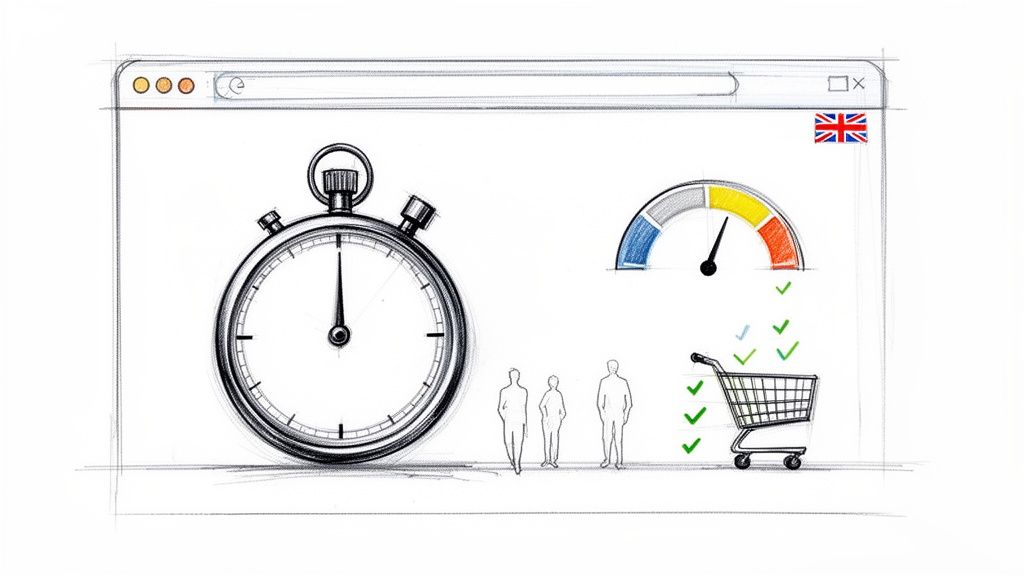
The Direct Cost of a Slow Website
This isn't just about making a good impression—slow loading times have a real, measurable impact on your bottom line. Think about the last time you tried to buy something online and the page just hung there, refusing to load. Did you wait it out, or did you get fed up and look elsewhere? Most of us do the latter.
This common frustration translates into tangible losses for UK businesses every single day.
- Lost Sales: For an e-commerce shop, a one-second delay in page response can cause a 7% reduction in conversions. A slow checkout is one of the biggest reasons people abandon their shopping carts.
- Fewer Leads: If a potential customer is trying to fill out your contact form but the page is lagging, they're far more likely to give up. You lose a valuable lead without even knowing they were interested.
- Damaged Brand Reputation: A slow website just feels unprofessional and untrustworthy. Visitors might start to associate your business with being outdated or unreliable, which slowly chips away at your brand's credibility.
This is exactly where a professional website optimisation service stops being a "nice-to-have" and becomes a critical business investment. It’s all about removing the friction that costs you money.
Speed is more than a feature; it's a fundamental aspect of the user experience. A fast website respects the user's time and builds immediate trust, creating a foundation for a positive customer relationship.
Speed as a Ranking Signal for Google
On top of the direct user experience, your website's speed is a huge factor in how well you show up in search engines. Google has been very clear that page speed is a ranking signal for both desktop and mobile searches. Why? Because Google’s main job is to give its users the best possible results, and a slow-loading page is, by definition, a poor result.
A faster website, therefore, gets a clear advantage. When your site loads quickly, search engine crawlers can index your pages more efficiently. Even more importantly, Google sees that users are less likely to "bounce" (leave straight away) from a fast site, which tells them your content is valuable and relevant.
The numbers don't lie. Website loading speed is a deal-breaker, with 40% of users abandoning a website that takes more than three seconds to load. This is even more critical on mobile, where 53% will leave under the same conditions. The websites that consistently hold the top spots on Google have an average load time of just 1.65 seconds—proving the direct link between speed and search visibility. You can explore more on how speed shapes user behaviour with these website statistics and trends.
Choosing Speed Through Optimised Hosting
The very foundation of a fast website is often its hosting environment. While a website optimisation service can work wonders on your site's software, the server hardware and its configuration play a massive part. Kicking things off with specialised UK web hosting can give you a significant head start.
For UK businesses focused on a local audience, having your website hosted on servers physically located in the UK cuts down on latency—that's the time it takes for data to travel from the server to your visitor's browser. This seemingly small geographical advantage can shave precious milliseconds off your load times, leading to a much better user experience and stronger SEO performance. You can find out more by reading our guide to choosing the best UK web hosting for your small business.
Winning Customers on Mobile Devices
The way your customers find you has completely changed. Forget the days when everyone was glued to a desktop computer. Today, your audience is browsing, shopping, and deciding what to buy from a smartphone – often while they’re on the go. For any UK business, thinking about mobile isn't just a tick-box exercise; it's the very foundation of a modern growth strategy.
This means we need to go far beyond a simple responsive design that just crams your desktop site onto a smaller screen. A proper website optimisation service is all about crafting an experience that feels natural and effortless on a mobile. It’s about understanding how people actually use their phones.

Beyond Responsive Design
Picture this: a potential customer sees your ad on their morning commute. They click through to your site on a packed train, ready to buy. A truly mobile-optimised site makes this a piece of cake.
So, what does a superior mobile experience actually involve?
- Thumb-Friendly Navigation: Buttons and links have to be big enough and spaced properly so they're easy to tap without hitting the wrong thing by mistake.
- Instant-Loading Images: Mobile users have even less patience than desktop users. Images need to be squeezed down specifically for mobile so they appear in a flash.
- Simplified Forms: Nobody wants to fill out a long, complicated form on a tiny screen. A mobile-first approach strips these down to the absolute essentials, making them quick and painless to complete.
If that commuter has to pinch and zoom to read your text, fumbles to tap a tiny button, or gives up waiting for a massive product image to load, you've lost them. It's as simple as that. A clunky mobile site is a direct roadblock to making money.
The Hard Numbers Behind Mobile-First
Shifting to a mobile-first mindset isn't just about being user-friendly; it's about following the money. The data tells a very clear story, with a staggering 61.72% of worldwide traffic now coming from mobile devices. That means the majority of your UK visitors are on their phones or tablets.
For UK businesses, mobile-friendly sites see 40% higher conversion rates, while a poor experience leads to a devastating 60% bounce rate. What's more, 74% of users are more likely to come back to a site that works well on their phone, which is a massive win for customer loyalty. You can dig deeper into how mobile design impacts user behaviour and business success in this detailed report.
A mobile-first approach isn't just about keeping up with a trend. It's a strategic move to meet your customers exactly where they are, making it incredibly easy for them to give you their business.
How Mobile Performance Affects Your Google Ranking
Make no mistake, your mobile site's performance has a huge and direct impact on how you show up in Google. Ever since Google rolled out its mobile-first indexing, it primarily uses the mobile version of your website to decide where you rank.
This means a slow, clunky mobile site doesn't just annoy users—it actively hurts your chances of getting found in the first place. Search engines want to show their users sites that are fast, accessible, and easy to use on a phone.
By investing in a professional website optimisation service that prioritises mobile, you’re not just boosting sales. You're also sending all the right signals to Google, helping you climb the rankings and get ahead of competitors still stuck in a desktop-first world.
How to Choose the Right Optimisation Partner
Picking a website optimisation service isn't like hiring a plumber to fix a leak. It’s more like bringing on a business partner who will be instrumental in your digital growth. Get it right, and you'll unlock new levels of performance and profit. A poor choice, however, can lead to endless frustration and a hole in your budget.
So, where do you start? A good partner looks beyond the code. They should be just as interested in your business goals and conversion rates as they are in server response times. This commercial focus is what separates a mere technician from a true growth partner.
Check Their Technical Chops and Infrastructure
First things first, you need to be sure they know their stuff, especially when it comes to your website's platform. For most UK businesses, that means they need deep, hands-on experience with WordPress and, for online stores, the complexities of WooCommerce. Don't be shy about asking for proof—case studies and examples of sites they’ve worked on are fair game.
Here's a crucial point many people miss: where are their servers physically located? If you're targeting UK customers, you absolutely need a partner who uses UK-based servers. It’s a simple matter of physics. The closer the server is to your visitor, the faster the data travels. This reduction in 'latency' means quicker load times, a happier customer, and even a leg up in local search rankings.
Here’s a quick checklist to run through with any potential provider:
- Platform Specialisation: Can they show you concrete examples of their work with your CMS (e.g., WordPress)?
- E-commerce Know-How: If you sell online, do they genuinely understand the unique performance drains of WooCommerce?
- Server Location: Are their servers based in the UK? This is a deal-breaker for serving a local audience.
- Measurement Tools: How do they plan to measure and report back on the improvements they make?
Look for Transparency in Price and Process
A partner you can trust is an open book. Their pricing should be crystal clear, with no nasty surprises or hidden fees down the line. Be sceptical of vague promises or prices that seem too good to be true—they often are. You need to know exactly what you’re paying for.
That transparency should also cover their way of working. Ask them to walk you through what happens after you sign up.
A professional onboarding isn’t just a welcome email. It’s a structured journey that should include a thorough site audit, a strategy call to align on goals, and a clear timeline. It’s designed to give you confidence, not leave you guessing.
Think of their onboarding as a test drive. If it feels organised, professional, and communicative, it’s a great sign that the rest of their website optimisation service is run with the same care and attention to detail.
Dig Into the Guarantees and Reporting
Finally, it’s time to look at the fine print and accountability. A formal Service Level Agreement (SLA) is non-negotiable. This is the document where they officially commit to targets for things like website uptime, support response times, and performance benchmarks. An SLA isn’t just jargon; it’s your guarantee of quality.
Just as important is how they’ll show you their work is paying off. You should expect regular reports that are easy to understand, even if you’re not a tech expert. These reports should track tangible results, showing you:
- Page Load Times: Simple before-and-after stats for your most important pages.
- Core Web Vitals: Clear data on how you’re scoring on Google's key user experience signals.
- Security Checks: A summary of scans performed and any threats neutralised.
- Uptime History: A clean record of your site’s availability to visitors.
Your website’s performance is the first impression you make. With 88.5% of web designers agreeing that slow loading is the number one reason people leave a site, you can't afford to get this wrong. For more on this, you can discover more insights about web design statistics. Choosing a partner who backs their work with clear, data-driven reports is the only way to ensure you're getting real value. To see how this philosophy is put into practice, take a look at our approach to managed WordPress hosting in the UK.
So, What's Next for Your Website?
Hopefully, you now see your website for what it truly is: a living, breathing part of your business, not a static brochure you set up once and then forget about. The journey from a sluggish, vulnerable site to a fast, secure, and profitable online hub is all about consistent, ongoing effort. It’s this dedication that really separates the winners from the also-rans online.
The path forward is actually quite straightforward. It all starts with a frank look at where your website is right now. Use the ideas we've covered in this guide to run a quick health check on your site's speed, security, and how it performs on a mobile phone. For most businesses, bringing in a professional website optimisation service is the quickest and most effective way to fix what's broken and unlock your site's real potential.
Time to Take Action
Ready to get the ball rolling? Here’s a simple three-step plan to get you started:
- Get a Baseline: Pop your website address into a free tool like Google PageSpeed Insights to see how you score. This isn't just a number; it's your starting line.
- Know Your 'Why': What do you really want your website to do? Is it about driving more sales, getting the phone to ring with new leads, or climbing the search engine rankings? A clear goal helps a provider create a strategy that actually works for you.
- Find the Right Partner: Look for someone who is upfront about their pricing, uses UK-based infrastructure (this matters for speed!), and has genuine experience with platforms like WordPress and WooCommerce.
Think of it this way: your website should be your hardest-working employee, attracting and converting customers 24/7. Investing in its performance isn't an expense; it's a direct investment in the future growth of your business.
Here at Vivihosting, we specialise in turning underperforming websites into valuable assets for UK businesses. We don't just tinker with the tech; we get to grips with what you're trying to achieve commercially. Our managed services are built to take the headache out of speed, security, and maintenance, so you can get back to what you do best—running your business.
Your journey to a better website starts with that first small step.
Your Website Optimisation Questions, Answered
Thinking about bringing in a professional to tune up your website? It's a big decision, and it’s completely normal to have a few questions before you commit. Let's tackle some of the most common ones I hear from business owners, so you can feel confident about the path forward.
How Long Does It Take to See Results?
This is the big one, isn't it? You'll see some changes almost straight away. Things like page load times and your scores on Google's Core Web Vitals often jump up dramatically within a few days of the main technical work being done. That’s the quick win.
But the real magic—the stuff that affects your bottom line—takes a little more patience. Seeing a real climb in search engine rankings or a noticeable bump in your conversion rates usually unfolds over several weeks, sometimes a few months. Think about it: search engines need time to revisit your site and recognise the improvements, and it takes a while for your customers' behaviour to shift in response to the better experience.
You could say it happens in two waves: first, you get the immediate technical boost, and then you see the compounding business growth as Google and your customers start to reward you for it.
Will This Whole Process Interrupt My Business?
Not at all—or at least, it absolutely shouldn't if you're working with a pro. A proper optimisation service is designed to be completely invisible to your customers. Most of the heavy lifting, like fine-tuning server settings, cleaning up your database, or compressing images, happens behind the scenes. We typically work on a separate 'staging' copy of your website.
This means your live website stays up and running, serving customers without a single hiccup. Any good provider will have a solid game plan, usually pushing the final changes live during your slowest period (like the middle of the night) to make the transition completely seamless. The goal is always zero downtime.
Is This a One-Time Cost or an Ongoing Expense?
It's a bit of both, really. The best way to think about it is in two distinct stages. First, there's the initial, in-depth project—the major overhaul that gets your website running in peak condition. This is where we sort out all the big, foundational problems and you see those huge performance gains.
But the web doesn't stand still. Your website's software needs updating, new security threats appear, and Google is always tweaking its algorithms. That's why some form of ongoing optimisation is vital to keep your site in top shape. This usually takes the form of a monthly maintenance plan. It’s less of a one-off fix and more of an ongoing investment in keeping your online presence fast, secure, and ahead of the competition.
At Vivihosting, our website optimisation service is built to give you those quick performance wins while setting you up for long-term business growth. Our UK-based team takes care of everything, making sure your site is fast, secure, and finely tuned to turn visitors into happy customers. Find out more about how we can help your business thrive at https://vivihosting.com.