

For any UK business with a website, a WordPress maintenance service isn't just another line on the expense sheet; it's a fundamental investment. Think of your website like a performance car. You wouldn't dream of driving it for thousands of miles without a service or an MOT. Your website needs that exact same level of proactive care to keep it running smoothly and securely.
Why WordPress Maintenance Is a Non-Negotiable Investment
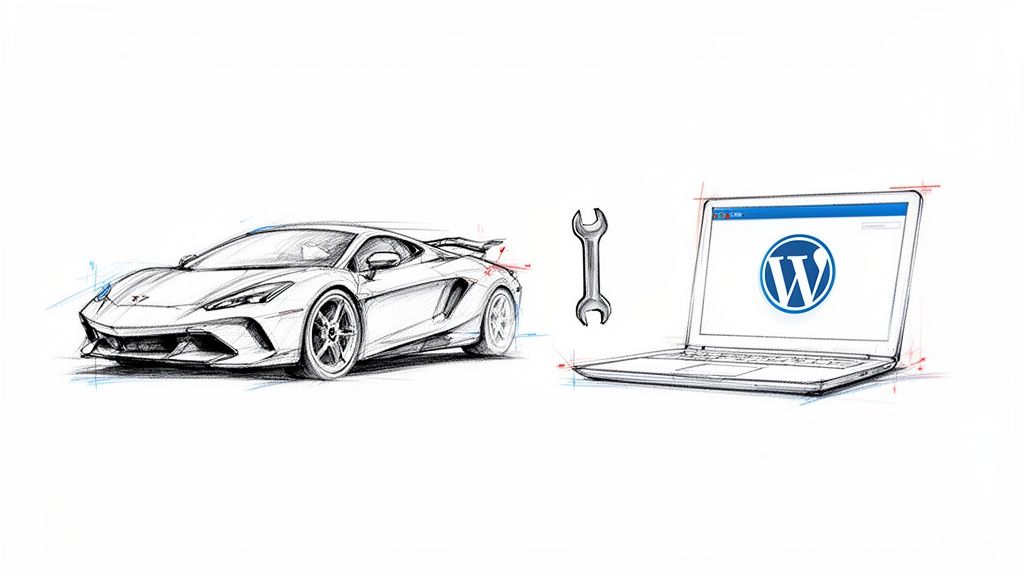
A 'set it and forget it' attitude is one of the biggest risks you can take with your WordPress site. Whether you’re a local artisan in Cornwall or a national retailer based in Manchester, your website is a living, breathing asset—not a static brochure. It’s built on layers of code from the WordPress core itself, your theme, and all the plugins you use, and this code is constantly being updated.
Without regular, professional attention, tiny cracks can start to appear in that foundation. Outdated plugins create security holes that are an open invitation for hackers. Your website’s speed can slow to a crawl, frustrating visitors and sending them elsewhere. Worst of all, a critical error could take your entire site offline without a moment’s notice. Proactive care is simply the best defence against these digital disasters.
The True Cost of Neglect
Putting off maintenance isn't a clever way to save a bit of cash; it's a high-stakes gamble. The fallout from a security breach, the lost sales from unexpected downtime, or the damage to your brand’s reputation will almost always cost far more than the modest fee for a professional maintenance plan.
Just think about the knock-on effects of a poorly maintained site:
- Security Breaches: A hacked website can mean stolen customer data, getting blacklisted by Google, and facing serious fines under UK data protection laws.
- Poor Performance: A slow website is a conversion killer. It damages the user experience and your SEO rankings, pushing potential customers straight to your competitors.
- Functionality Failures: Imagine your contact form stops working, or the checkout process breaks. These aren't just glitches; they are direct hits to your revenue and operations.
A professional maintenance plan is basically business insurance for your digital shopfront. It gives you the peace of mind that an expert team is constantly watching over, updating, and fine-tuning your most important online asset.
The UK WordPress Ecosystem
The need for this dedicated care is even greater when you consider just how popular WordPress is. Here in the United Kingdom, it powers an incredible 1,362,281 websites, which is over 60% of all sites built with a known content management system. This popularity, however, makes it a huge target for cyberattacks.
It's no surprise, then, that 95.3% of WordPress service providers make core, plugin, and theme updates their absolute top priority—it’s the front line in closing security gaps. You can discover more insights about why WordPress maintenance is crucial over on fixmysite.com.
This is where a dedicated wordpress maintenance services uk provider comes in. They handle all the technical heavy lifting, from security scans and software updates to performance tuning and backups. That frees you up to focus on what you do best: running and growing your business.
What’s Actually in a WordPress Maintenance Plan?
So, what are you really getting when you invest in a WordPress maintenance plan? It's easy to see it as just another subscription, but it’s much more than that. Think of it as hiring a dedicated team to protect and fine-tune your most important digital asset.
A good way to picture it is like a property manager for your business's physical premises. They make sure the doors are locked, the lights are on, and everything is running smoothly so you can focus on your customers. Each part of a maintenance service plays a crucial role in keeping your digital shop in top condition.
The Cornerstone: Regular Updates
At its heart, WordPress is constantly evolving. The core software, along with all your themes and plugins, receives regular updates from developers. These aren't just for shiny new features; many are critical security patches designed to close vulnerabilities that hackers have discovered.
Putting off these updates is like leaving your back door unlocked. It's an open invitation. Hackers specifically hunt for sites running outdated software because they are by far the easiest targets. A proper maintenance service handles this methodically:
- First, they test. All updates are applied to a safe 'staging' copy of your site to ensure nothing breaks.
- Then, they schedule. Updates are rolled out at times that cause the least disruption to your visitors.
- Finally, they have a fallback. If a new update causes an unexpected issue, they can immediately roll it back to the previous version.
This careful, step-by-step process prevents the all-too-common scenario where a simple update accidentally takes down your entire website.
Your Digital Insurance Policy: Scheduled Backups
Ask yourself this: what would happen if your website was wiped out tomorrow by a server crash or a hack? If you don't have a recent backup, the answer is pretty devastating. You'd lose your content, your customer data, your order history—everything.
Scheduled backups are your fire escape. A reliable provider doesn't just save a copy of your site; they create complete backups of all your files and your database, storing them securely in a separate location.
The real question isn’t if you back up, but how often. A simple brochure site might only need a monthly backup. But for a busy WooCommerce store taking orders every day, you'll want daily, or even real-time, backups to avoid losing crucial sales data.
The 24/7 Watchman: Proactive Security Monitoring
Good maintenance goes beyond simply reacting to problems. It involves active, round-the-clock security monitoring—essentially, a digital security guard who never sleeps.
This isn't just one tool; it's a layered defence system:
- Malware Scanning: Your site's files are regularly swept for any malicious code.
- Firewall Management: A Web Application Firewall (WAF) acts like a bouncer, filtering out suspicious traffic before it can even get to your site.
- Login Protection: Measures are put in place to stop 'brute-force' attacks, where bots hammer your login page trying to guess your password.
- Uptime Monitoring: You get an instant alert the moment your website goes down, so the team can jump on it and get you back online fast.
This proactive approach means most threats are dealt with long before you or your customers ever know they were there. To see how these activities fit into a wider strategy, it’s useful to understand the broader concept of website managed services.
Fine-Tuning the Engine: Performance Optimisation
In today's fast-paced world, speed is king. A slow website doesn't just annoy visitors; it actively harms your search engine rankings. Performance optimisation is the ongoing work of making sure your site loads lightning-fast for everyone, especially for your UK audience.
This is a continuous process, not a one-off task. A maintenance team will typically handle:
- Database Optimisation: Your WordPress database gets cluttered over time with old post revisions and spam comments. Cleaning this out is like decluttering your office—everything runs more efficiently.
- Image Compression: Large image files are one of the biggest culprits of slow load times. They are carefully compressed to reduce their size without any noticeable drop in quality.
- Caching Implementation: Caching creates static, ready-to-go versions of your pages. This means they can be delivered to visitors almost instantly, rather than being built from scratch every single time.
Each of these tweaks adds up to a much smoother, faster experience that keeps people on your site and helps turn them into customers. If you're looking for a partner to take care of these critical tasks, have a look at our comprehensive website maintenance packages to find a plan that suits your business.
How to Choose the Right UK WordPress Partner
Finding the right provider for WordPress maintenance services UK businesses can rely on is a lot more than just shopping around on price. You’re looking for a genuine partner – someone who gets what you’re trying to achieve and has the technical chops to protect your most important digital asset.
This decision will directly impact your site's security, its speed, and its overall health for years to come. A good partner is like having a specialist on your team, proactively heading off problems before they even start. The wrong one? Well, that often means slow support, lingering issues, and a constant worry at the back of your mind.
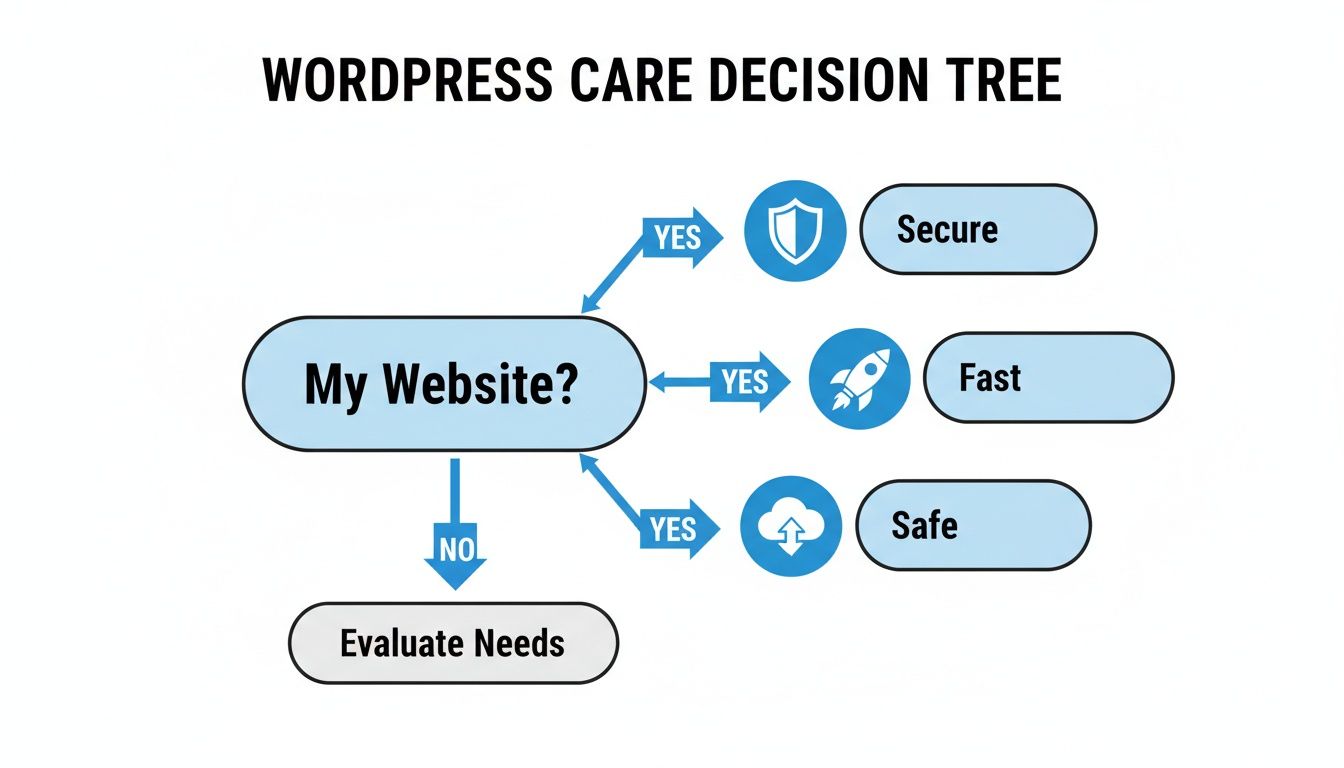
To make the right choice, you need to dig deeper than the sales pitch and ask the right questions.
Key Questions to Ask Potential Providers
Think of this process like hiring a key team member. You wouldn't hire a new manager without a proper interview, so don't sign up for a maintenance plan without doing your due diligence. Here are a few essential questions to get you started:
- Where are your servers physically located? This is a big one. For a UK business with a UK audience, having servers based in the UK is a massive advantage for site speed and SEO. Data that doesn't have to cross an ocean simply gets there faster.
- What are your guaranteed support response times? When your website goes down, every second feels like an hour. You need a clear Service Level Agreement (SLA) that tells you exactly how quickly they’ll jump on a problem, not just a vague promise of "fast support."
- Do you have real experience with WooCommerce? If you're running an e-commerce store, this is a deal-breaker. WooCommerce sites are a different beast entirely, with complex needs around payment gateways, customer data, and performance. You need someone who has been there and done that.
Freelancer vs Specialist UK Agency
The kind of provider you choose makes a huge difference. A freelancer might seem like a cost-effective option for a small brochure site, but as your needs grow, a specialist agency often provides a much deeper pool of expertise and more robust systems.
When you’re weighing your options, consider the different strengths each type of provider brings to the table. This is especially true when it comes to communication; clear and consistent updates are crucial. In fact, strong client communication best practices are often a hallmark of a professional agency setup.
To help you visualise the trade-offs, here’s a quick comparison.
UK WordPress Maintenance Provider Comparison
| Feature | Freelancer | Generalist Agency | Specialist UK Provider (like Vivihosting) |
|---|---|---|---|
| Cost | Often the lowest price | Mid-to-high, bundled with other services | Competitive, focused value |
| Expertise | Varies greatly; can be a generalist | Broad digital marketing skills | Deep, specialised WordPress knowledge |
| Availability | Limited; often a one-person operation | Team-based, but may not be WordPress experts | Dedicated support team with defined hours |
| Proactive Care | Usually reactive; fixes things when they break | Varies; maintenance might be an add-on | Proactive monitoring and updates are core |
| UK-Specific Focus | Unlikely to be a primary focus | Rarely a specialism | Core focus on UK performance and compliance |
| Scalability | Limited ability to handle growth | Can scale, but WordPress isn't the priority | Built to grow with your business |
As you can see, the right choice really depends on your specific needs and where your business is heading.
The demand for this kind of support is booming. The UK WordPress maintenance market is set for a 12% CAGR through 2033, which isn't surprising when you consider there are over 1.3 million UK WordPress sites out there. A recent survey highlighted that European & UK providers made up 30.6% of those polled, with 85.3% offering crucial services like malware removal.
Making the Final Decision
At the end of the day, your decision comes down to balancing cost against expertise and reliability. A freelancer’s lower price tag might be tempting, but a specialist agency offers something more valuable: peace of mind. You're paying for structured support, a team of experts, and the ability to scale without worry.
So, ask yourself what you truly need. Is it just a basic safety net, or are you looking for a proactive partner who can offer strategic advice to help you grow? Your answer will point you in the right direction. For businesses ready to find a dependable, long-term partner, exploring established WordPress agencies in the UK is a great place to start. Choose a provider that is as invested in your success as you are.
Meeting UK-Specific Website Requirements
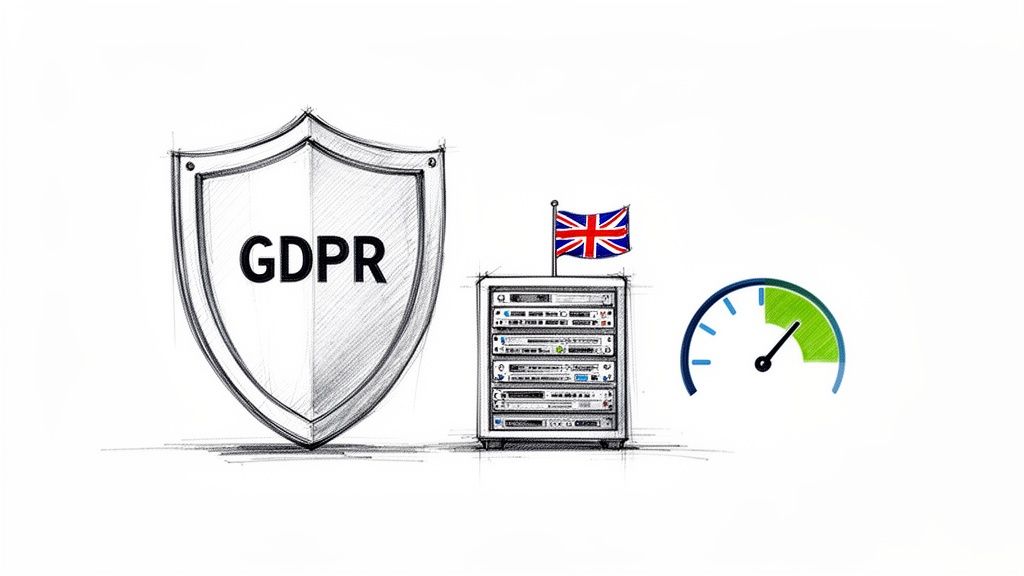
Running a website for a UK audience isn't just about using the right spelling and currency. You're operating under a specific set of rules, and your customers have high expectations for speed and security. Getting these local details wrong can land you in legal hot water and, just as importantly, damage the trust you’ve built with your visitors.
There are two critical areas every UK business must get right: data protection under GDPR and the physical location of your web server. These aren't just tick-box exercises; they're foundational to building a credible, successful online presence in the UK.
A proper provider of WordPress maintenance services UK businesses rely on will be well-versed in these local nuances, making them a crucial ally for both compliance and performance.
Getting to Grips with GDPR Compliance
GDPR isn't a vague guideline—it's the law governing how you must handle the personal data of anyone in the UK and Europe. For your WordPress site, this impacts everything from a basic contact form right through to your online shop's checkout process.
At its core, GDPR is about transparency and consent. You have to be upfront about what data you're collecting, why you need it, and get clear permission from the user first. In practice, this means nailing a few key things:
- Cookie Consent: Your site needs a compliant cookie banner that gives users a genuine choice to accept or reject non-essential cookies.
- Privacy Policies: You must have a privacy policy that's easy to find, written in plain English, and clearly explains how you protect and use people's data.
- Data Handling: Any personal information gathered via forms needs to be stored securely and used only for the purpose you stated.
Staying GDPR compliant isn't a "set it and forget it" task. It's an ongoing process. Regulations change, and as you add new plugins or features to your site, you’ll need to make sure your compliance keeps up. A good maintenance partner helps ensure the technical side of your website properly supports these legal duties.
The Need for Speed: Why UK-Based Servers Matter
Think about it like this: ordering a takeaway from a restaurant down the road will always be faster than ordering one from another city. The same logic applies to your website. The physical distance between your website’s server and your visitor directly impacts how fast your site loads for them.
When someone in Manchester tries to view a site hosted in California, the data has to zip thousands of miles across undersea cables. Even at the speed of light, that journey creates a small but noticeable delay called latency.
By hosting your website on a server physically located in the UK, you slash that latency for your local audience. This gives you a few significant wins:
- A Better User Experience: Faster-loading pages mean happier visitors. They’re less likely to get frustrated and click away.
- Improved SEO Rankings: Google and other search engines reward speed. A quicker site has a better chance of ranking higher in UK search results.
- Data Sovereignty Confidence: Keeping UK customer data on UK soil can also simplify your data protection compliance.
Choosing a provider with UK-based servers is one of the smartest decisions you can make for your website. It’s a strategic move that optimises your site for the people who matter most: your local customers. You can learn more about this in our guide to managed WordPress hosting in the UK.
Understanding WordPress Maintenance Costs and What You Get for Your Money
When you start looking into professional WordPress maintenance services UK-based businesses need, cost is always front and centre. It’s easy to see it as just another line item on your monthly outgoings, but honestly, that’s looking at it the wrong way. A better way to think about it is as a sort of insurance policy for your most important digital asset.
The price you pay for this peace of mind can vary quite a bit, but it’s always linked to the level of support and protection your website actually needs. You're not just paying for a list of tasks; you're investing in an expert team that proactively stops things from going catastrophically wrong.
Breaking Down the Pricing Tiers
Here in the UK, you’ll find that most WordPress maintenance plans are bundled into different tiers. This is a sensible approach because it means you only pay for what your site truly needs, whether it's a simple local business site or a bustling online shop.
Basic or Starter Plans: These are spot-on for small 'brochure' websites or personal blogs that don't get swamped with visitors. They cover the non-negotiables: core WordPress updates, weekly backups, and basic security scans. Think of it as the foundational safety net every single website should have.
Professional or Business Plans: This is the sweet spot for most growing businesses. These plans step things up with more frequent backups (usually daily), beefier security like a Web Application Firewall (WAF), and performance tweaks to keep your site zipping along as your traffic grows.
Premium or E-commerce Plans: If you're running a WooCommerce store, this is where you need to be. These top-tier plans come with specialist support, real-time backups to protect every last order, advanced security to keep customer data locked down, and priority support for any urgent problem that could hit your sales.
The main reason for the price jump between tiers comes down to two things: risk and complexity. An e-commerce site handling payments has a lot more on the line than a simple portfolio, which naturally calls for a more robust and responsive service.
What’s the Real Return on Investment?
Just looking at the monthly fee misses the whole point. The true value of a maintenance plan snaps into focus when you weigh that modest cost against the potential financial disaster of doing nothing.
Let's just think about the cost of one single major incident:
- The Price of Downtime: If your website went down for a day, how much money would you lose? For an online shop, that could easily run into thousands of pounds from lost sales and shoppers giving up.
- The Cost of a Hack: A hacked website is a genuine nightmare. Getting a specialist to perform an emergency clean-up can cost hundreds, sometimes thousands, of pounds. And that’s before you even start to think about the damage to your brand’s reputation or potential fines for data breaches.
- The SEO Hit: Google punishes slow and insecure sites. Your search rankings could tumble off a cliff, choking off that valuable stream of organic traffic. Winning back that authority is a slow, expensive grind.
When you actually do the maths, a professional maintenance plan stops looking like a cost and starts looking like a cost-prevention strategy. It’s a predictable monthly fee that shields you from unpredictable and potentially business-crippling financial shocks.
At the end of the day, the right plan gives you more than just technical support. It gives you the freedom to focus on running your business, safe in the knowledge that a team of experts is keeping your digital shopfront secure, fast, and always open for customers.
WordPress Maintenance: Your Questions Answered
When you're looking into professional WordPress maintenance, a few questions always seem to pop up. It's completely normal. Getting straight answers is key to picking the right service for your UK business, so let's tackle some of the most common queries we hear.
How Often Does My WordPress Site Need Maintenance?
Think of it like getting an MOT for your car. You wouldn't wait for something to break before getting it checked, and the same goes for your website.
To keep things secure and running smoothly, you need a routine. Critical security updates for plugins and themes, for example, really should be checked and applied weekly. This is your first line of defence against newly discovered threats. Then, on a monthly basis, a deeper health check is essential—things like optimising your database and making sure your backups are working perfectly.
Can I Just Handle the Maintenance Myself?
You absolutely can, but it's important to be honest about what that entails. Going the DIY route demands a regular time commitment, a good grasp of the technical side of WordPress, and being prepared to handle the fallout if something goes wrong. You're not just clicking "update"; you're troubleshooting plugin conflicts and figuring out how to restore your site when an update breaks it.
The real difference boils down to proactive expertise. A professional service isn't just applying patches. They're managing a whole system for performance and security, using specialist tools you wouldn't have access to. You're paying for their experience and the peace of mind that an expert has your back.
What’s the Difference Between Hosting and Maintenance?
This is a classic point of confusion, but the distinction is vital. Think of it this way: web hosting is like the plot of land you rent to build your house on. It’s the server space and the basic utilities that allow your website to exist online in the first place.
Website maintenance, on the other hand, is the ongoing upkeep of the house itself. It's the security system, the regular repairs, the deep clean, and the performance tune-ups that keep everything in perfect working order for your visitors. While some hosts offer basic add-ons, a dedicated WordPress maintenance services UK plan provides far more specialised, in-depth care.
Hosting gives your website a home; maintenance keeps that home safe, clean, and running efficiently for every visitor who stops by.
If My Site Gets Hacked, How Quickly Can It Be Fixed?
This really depends on your provider and the plan you're on. Any reputable service will have a clear Service Level Agreement (SLA) that tells you exactly how fast they’ll respond to a critical issue like a hack, which should be within a few hours.
The best strategy, though, is always prevention. A solid maintenance plan is built to stop hacks from happening in the first place by keeping every vulnerability sealed. A good service will always have an emergency recovery plan, but their main job is to make sure you never, ever have to use it.
Protecting your website is protecting your business. At Vivihosting, we provide specialised, UK-based WordPress maintenance that keeps your site fast, secure, and always ready for business, so you can focus on growth. Explore our maintenance plans today.