


Think of a website maintenance package as a retainer for a team of expert mechanics for your website. It’s a recurring service that handles all the technical, behind-the-scenes jobs needed to keep your site running smoothly, securely, and quickly. This covers everything from software updates and security scans to regular backups, freeing you up to concentrate on running your business.
Your Website Is a Living Business Asset
It’s easy to see your website as a digital brochure – something you create once and then forget about. But that’s a real mistake. A better way to think of it is as your most dedicated employee, working 24/7 to find leads, make sales, and be the public face of your brand. And just like any valuable asset, it needs consistent care to keep performing at its peak.
Treating your website as a one-and-done project is a common pitfall that often leads to trouble down the line. The web is always changing. New security threats pop up constantly, software needs updating to stay secure and compatible, and visitor expectations for speed are always rising. Ignoring this is like buying a brand-new car and expecting it to run perfectly forever without a single oil change. Eventually, it’s going to break down.
Why Proactive Care Is Essential
Without regular attention, your site will inevitably slow down, become riddled with small bugs, and be left wide open to hackers. A professional website maintenance package flips the script from reactive fire-fighting to proactive, preventative care. It's about spotting and fixing potential issues before they become full-blown emergencies that knock your site offline.
This ongoing support keeps your digital storefront in top condition, which has a direct impact on your business's health. The advantages go well beyond just keeping the site online:
- Protects Your Investment: It safeguards the significant time and money you’ve already put into your website's design and build.
- Ensures Business Continuity: It helps you avoid the dreaded downtime that costs you sales and damages your reputation.
- Builds Customer Trust: A fast, secure website sends a powerful signal to visitors that you are a professional and trustworthy business.
A well-maintained website isn’t just a technical nicety; it’s a cornerstone of modern business strategy. It reflects your brand’s commitment to quality and security, directly influencing customer perception and your bottom line.
Ultimately, signing up for a maintenance plan is an investment in your own peace of mind. It takes the technical worries off your plate, letting you focus on what you do best: growing your business. This guide will walk you through exactly what these packages include and how they protect your digital asset from a world of potential problems.
What’s Really Inside a Website Maintenance Package?
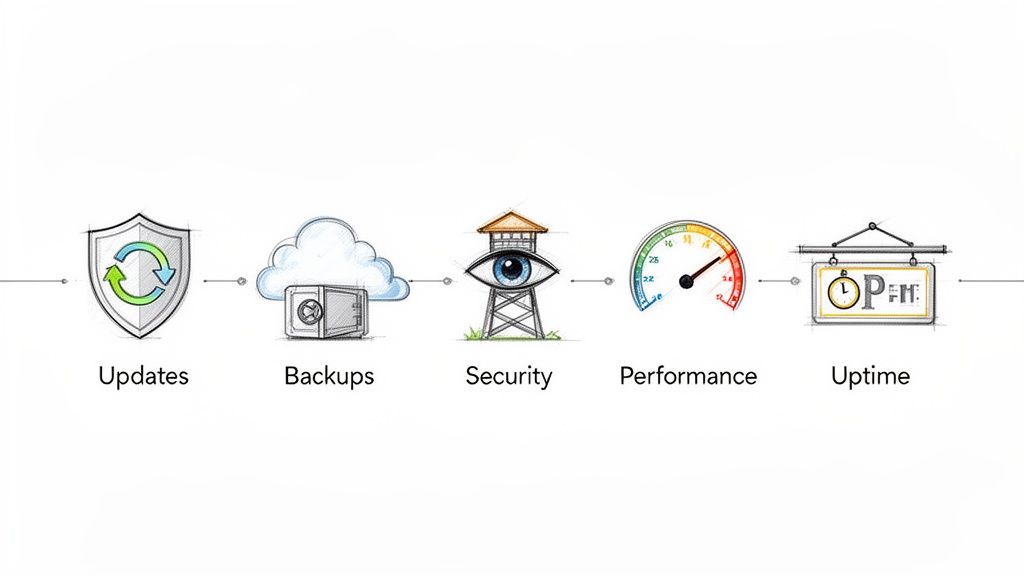
A good website maintenance package is so much more than a technical to-do list. The best way to think of it is as a complete care plan for your most valuable digital asset. To really get why it’s so important, we need to lift the bonnet and have a proper look at the engine—the essential services that keep your business running online.
Every part works together to keep your site fast, safe, and dependable. Let one of these slip, and your entire website becomes vulnerable to problems that can cause expensive downtime and seriously dent your brand's reputation.
H3: Software and Plugin Updates
Think of your website's software—the core system (like WordPress), your theme, and all its plugins—as its immune system. Just like our bodies need to fight off new germs, your website’s code needs constant updates to protect it from the latest security threats that hackers and developers find.
These updates aren't just 'nice-to-haves'; they're your absolute first line of defence. Outdated software is the number one way hackers get in, as they specifically hunt for sites running old, vulnerable versions. A professional maintenance plan makes sure these updates are carefully tested and applied quickly, closing security holes before anyone has a chance to exploit them.
H3: Scheduled Backups
A website backup is your digital insurance policy, plain and simple. It’s a complete copy of every file and all the data on your site, tucked away safely in a separate location. If the worst should happen—a server fails, you get hacked, or someone makes a critical mistake—a recent backup lets you turn back the clock and restore your site with minimal fuss.
Without regular, reliable backups, you're one disaster away from losing everything. A comprehensive website maintenance package will always include automated backups running at frequent intervals. This could be daily for a busy e-commerce shop or weekly for a simpler brochure-style site, but the goal is the same: to make sure your hard work is always safe.
H3: Proactive Security Monitoring
While updates patch known weak spots, proactive security monitoring is your 24/7 digital bodyguard. This service is always on, actively scanning your site for malware, strange activity, and any attempts to break in. It's all about catching and stopping threats in real-time, long before they can do any real damage.
This isn’t a one-off scan; it’s a constant, vigilant process. It typically includes:
- Malware Scanning: Routinely checking your website’s files for any malicious code that’s been snuck in.
- Blacklist Monitoring: Making sure your site hasn’t been flagged as unsafe by search engines like Google, which can kill your traffic overnight.
- Firewall Management: Actively blocking dodgy traffic and known threats from ever reaching your website in the first place.
Security monitoring turns your website’s defence from a simple brick wall into a sophisticated alarm system. It gives you the peace of mind that an expert is constantly watching over your digital shopfront, protecting your business and your customers.
This round-the-clock watchfulness is a non-negotiable part of any professional maintenance service. To deliver this kind of consistency, many modern packages lean heavily on automated infrastructure management, which helps explain how they can offer such reliable and efficient protection.
H3: Performance Optimisation
Online, speed is currency. A slow website doesn't just annoy visitors; it actively damages your search engine rankings and can cripple your sales. Performance optimisation is like a regular engine tune-up for your site, making sure it runs as fast and smoothly as possible.
This involves a whole host of technical tweaks designed to slash page load times. We’re talking about things like optimising image sizes, cleaning up code, using browser caching effectively, and fine-tuning the database. Each tiny improvement adds up, creating a much better experience for your users and encouraging them to stick around longer.
H3: Uptime Monitoring
Finally, uptime monitoring is what ensures your 'Open for Business' sign is always lit. This service works around the clock, constantly pinging your website to check it’s online and available to visitors.
If your site ever goes down, even for a moment, an uptime monitor sends an instant alert to your maintenance team. This means they can jump on the problem and get it fixed immediately—often before you or your customers even notice anything is wrong. For any online business, minimising downtime is absolutely vital for protecting revenue and maintaining trust.
The Business Case for Website Maintenance
It’s one thing to understand the technical checklist of what goes into a website maintenance package, but it’s another thing entirely to see how those services directly impact your bottom line. Let's move beyond the features and talk about the real-world benefits that make this a strategic investment, not just another recurring cost.
This isn’t about just ‘keeping the lights on’. It’s about making sure your most valuable digital asset is working hard for your business, actively helping you grow. Every part of a professional maintenance plan translates into tangible advantages that protect your revenue, your reputation, and your customer relationships.
Enhanced Security and Brand Trust
In today's world of constant cyber threats, solid website security is simply not optional. A single data breach can be devastating, resulting in hefty fines, shattered customer trust, and brand damage that’s incredibly difficult to repair. Regular maintenance is your first line of defence, methodically patching security holes and proactively monitoring for threats before they become a problem.
Think about it: when your customers feel confident that their information is safe with you, they're far more likely to make a purchase and come back again. That foundation of trust is everything in modern business.
A secure website isn’t a luxury anymore—it’s a fundamental expectation. Proactive maintenance acts as a powerful deterrent, protecting not just your data, but the invaluable trust you’ve built with your customers.
Improved User Experience and Conversions
You’ve got seconds to make a first impression online. A slow, buggy, or broken website is a surefire way to send potential customers running straight to your competitors. A professional website maintenance package keeps your site fast, reliable, and easy to use, creating a smooth experience that encourages people to stick around and take the next step.
A high-performing website simply reduces friction. This has a direct knock-on effect:
- Lower Bounce Rates: Visitors don't hit the back button out of frustration.
- Higher Engagement: People are more willing to explore your pages and content.
- Increased Conversions: A seamless path from the homepage to checkout means more sales and enquiries.
Investing in a solid website maintenance plan is a business decision that empowers your team to implement top-tier customer support best practices, which feeds into better customer satisfaction and loyalty across the board.
Better SEO Performance and Visibility
Search engines like Google have a clear preference for websites that are healthy, fast, and secure. Technical SEO isn't just a buzzword; it's a critical ranking factor, and a well-maintained site ticks all the right boxes. Regular performance tweaks, fixing broken links, and ensuring everything works perfectly on mobile are all strong signals to Google that your site offers a great user experience.
Put simply, consistent maintenance helps you climb the search rankings, making it easier for new customers to find you. If you neglect it, your visibility will slowly but surely decline, handing a gift-wrapped advantage to your competitors.
Ultimate Peace of Mind and Focus
Perhaps the most valuable benefit is the one you can’t easily measure: peace of mind. Knowing an expert team is keeping a watchful eye on your website frees you from worrying about technical glitches, security alerts, or unexpected crashes. You get to focus your time and energy on what you do best—running and growing your business.
The numbers back this up. The UK's Data Processing & Hosting Services industry, which covers website maintenance, hit a market size of £10.8 billion in 2026. This shows just how essential these services have become for businesses of all sizes. Find out more about the UK's growing data services market. It's a proactive approach that turns your website from a potential source of stress into a reliable engine for success.
How to Choose the Right Maintenance Package
Picking the right website maintenance package can feel a bit overwhelming, but it doesn't have to be. The trick is to look past the price tag and focus on what your business genuinely needs to thrive and stay secure online. Think of it like insurance; you want the right level of cover for what you’re protecting.
By matching the services to your website's actual demands, you avoid paying for bells and whistles you don't need, or worse, leaving your most valuable digital asset vulnerable. A quick, honest assessment is all it takes to figure out what’s right for you.
Assess Your Website's Role and Risks
First things first: how important is your website to your day-to-day business? A simple online portfolio for a photographer has vastly different requirements than a busy e-commerce shop processing orders 24/7. The goal here is to get a clear picture of your operational dependency and risk level.
To get started, just ask yourself a few straight-talking questions:
- How critical is my website to daily operations? If your site is your main engine for leads or sales, any downtime directly costs you money. This immediately puts you in a higher-risk category.
- Do I process payments or handle sensitive user data? Any site handling personal details or financial info, like a WooCommerce store, needs top-tier security monitoring and very frequent backups. It's non-negotiable.
- What's my expected website traffic? High-traffic sites are a bigger target for hackers and put more strain on the server. They need plans that include performance tuning and beefed-up security.
- How often do I update my content? If you have a blog that's updated daily or a shop with constantly changing products, you'll want a plan with more regular backups so you never lose your latest work.
Once you’ve got the answers, you can start matching them to what different maintenance packages offer. For example, if your website is the lifeblood of your business and it takes payments, a premium package with daily backups and advanced security isn't a cost—it's an essential investment.
This thought process shines a light on why professional maintenance is so valuable, as it directly supports your business goals.
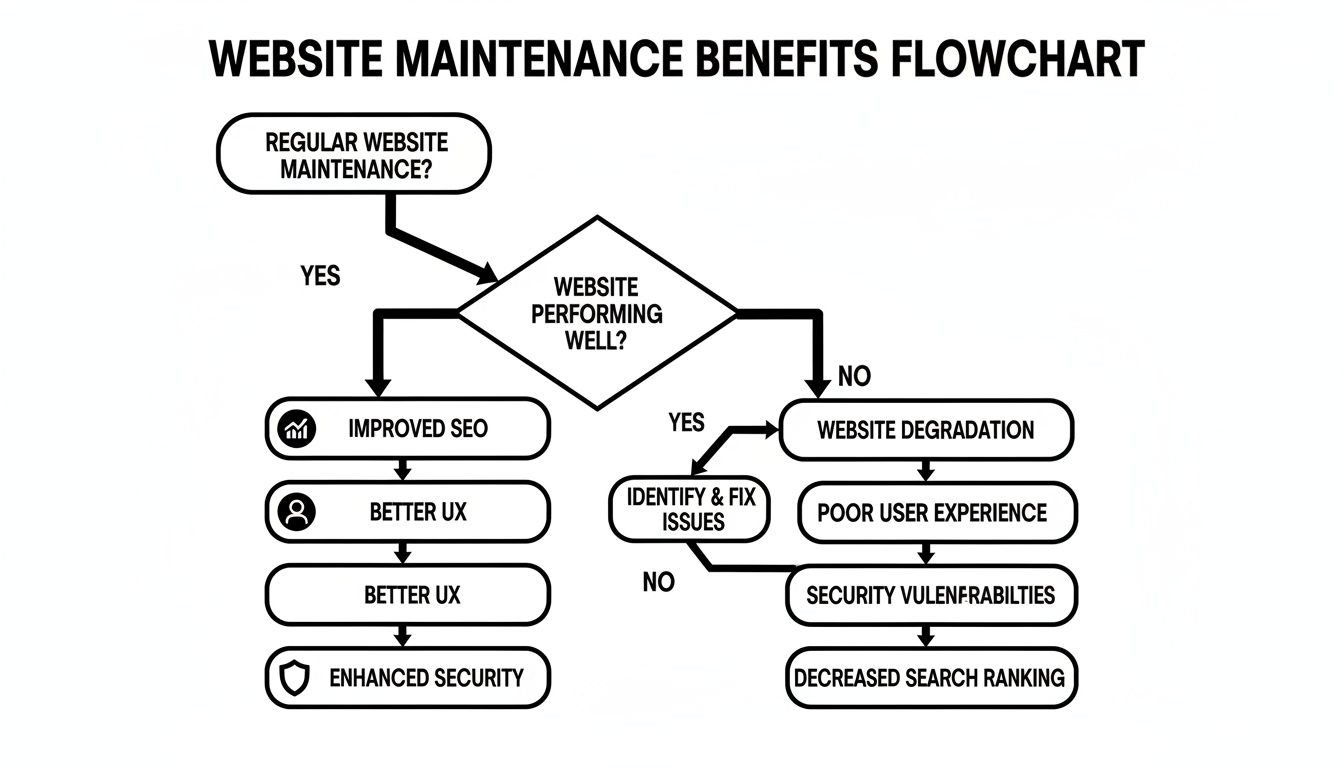
As you can see, consistent maintenance is a virtuous cycle. It leads to better search rankings, a smoother experience for your customers, and stronger security for your data. On the flip side, neglect creates a spiral of problems, from poor SEO to security holes that can really damage your business.
Understand the Service Level Agreement
Beyond the checklist of features, one of the most vital parts of any maintenance package is the Service Level Agreement (SLA). This is the contract that spells out, in black and white, what you can expect in terms of support, response times, and service quality. It’s what gives you real peace of mind.
A good SLA cuts through the jargon and sets clear, measurable promises. It should precisely define things like:
- Response Time: How quickly the support team will acknowledge your ticket.
- Resolution Time: The target window for fixing issues, usually categorised by severity (e.g., "critical" vs. "minor").
- Support Hours: The times you can actually get help (e.g., standard UK business hours vs. 24/7).
- Communication Channels: How to get in touch—is it by email, phone, or a dedicated support portal?
A strong SLA is your guarantee of service quality. It transforms a vague promise of "support" into a concrete commitment, ensuring you know exactly who to call and how quickly they'll act when an issue arises.
Always read the SLA carefully. If your business operates outside the typical 9-to-5, a plan offering 24/7 emergency support is crucial. For someone else, knowing a non-urgent request will be sorted within one business day might be perfectly adequate. The SLA ensures the service you're paying for truly fits how you work.
Our managed website services come with clear SLAs designed specifically for UK businesses. By properly assessing your needs and understanding the service agreement, you can confidently choose a maintenance package that delivers real value and robust protection.
Understanding the Cost of Website Maintenance

When looking into a website maintenance package, the first question is nearly always the same: "So, how much is this going to cost?" There’s no single price tag, because the cost really hinges on what your specific website needs to thrive.
Think of it like getting a car serviced. The basic MOT and oil change for a small run-around is going to cost a lot less than a full service for a high-performance commercial van that’s on the road 24/7. In the same way, a simple five-page brochure site has very different needs to a bustling e-commerce store handling hundreds of daily orders. The more complex the website, the more hands-on the care it requires, and that's reflected in the price.
What Shapes the Price?
The cost of a website maintenance package in the UK comes down to the specifics of your site. The more intricate it is, or the more critical it is to your business operations, the more comprehensive (and therefore more expensive) the plan will be.
Here are the main things that influence the final price:
- Website Complexity: A straightforward, five-page informational website is much easier to look after than a site with dozens of pages, custom-built features, or a members-only area.
- E-commerce Functionality: Online shops, especially those built on platforms like WooCommerce, need constant attention. Security for payments and protecting customer data is paramount, which naturally bumps up the maintenance cost.
- Level of Support: A plan that includes 24/7 emergency support for when things go wrong will cost more than one limited to standard UK office hours.
- Frequency of Backups: An active online store needs daily, if not hourly, backups. This is far more resource-heavy than running a weekly backup for a simple blog that’s updated once a week.
Thankfully, there’s plenty of competition, which keeps pricing reasonable. Recent UK website cost statistics show the median average cost for a website maintenance package is around £15.90 per month, with the mean average sitting at £68.25 per month. This big difference highlights how plans scale from the bare essentials for a personal blog right up to fully managed services for growing businesses. If you want to dig into the numbers, the latest UK website cost analysis has some great insights.
The Cost of Doing Nothing vs. The Cost of Investing
It’s easy to see maintenance as just another business expense, but that’s not the full story. A better way to look at it is as a smart investment in protecting your business from risk. The real question isn't "What does a maintenance package cost?", but rather, "What could it cost me if I don't have one?"
Think about what could go wrong. A single security breach could result in massive costs from data recovery, GDPR fines, and a catastrophic loss of customer trust. An unexpected website crash during your busiest sales period could mean thousands of pounds in lost revenue in just a few hours. These are the kinds of expensive, high-stress emergencies that maintenance plans are designed to prevent.
A predictable monthly fee for maintenance is an investment in stability. It transforms the potential for a catastrophic, unbudgeted expense into a manageable operational cost, giving you crucial peace of mind.
A good package also offers excellent value for money. When you bundle services like premium security plugins, performance optimisation tools, and access to expert support, it's far more cost-effective than trying to buy them all separately. You’re not just paying for a checklist of tasks; you're investing in a team dedicated to keeping your most valuable digital asset secure, fast, and reliable. For a deeper dive, check out our complete guide to website hosting and maintenance.
Protecting Your Most Important Digital Asset
When you think about it, your website is one of your business's most valuable assets. It’s your digital front door, your 24/7 salesperson, and often the first impression a new customer has of you. Treating a website maintenance package as an optional extra is like leaving your main office unlocked overnight. It's just not something you'd risk.
That's why professional, proactive care isn't a luxury—it's a cornerstone of any smart business strategy today. Proper maintenance keeps your digital storefront secure, fast, and working exactly as it should, day in and day out. This builds a stronger brand reputation, gives your customers a much better experience, and lays the groundwork for real, sustainable growth.
From Reactive to Proactive
This is all about shifting your mindset from putting out fires to preventing them in the first place. You stop lurching from one costly emergency to the next and instead, have a team watching over things, catching small issues before they snowball.
Investing in your website’s upkeep is one of the smartest decisions you can make for its long-term health. A dedicated maintenance plan is the difference between constantly worrying about what might break and having the peace of mind to focus on what you do best—running your business.
Think of this as your call to action. It’s time to secure your digital presence and make sure it keeps working for you, not against you. Protecting this asset means you’re safeguarding your revenue, your reputation, and your future. A solid backup strategy, for instance, is a critical piece of this puzzle. If you're on WordPress, our guide on how to properly back up your WordPress site is a great place to start understanding why it's so important.
Your website is your hardest-working employee, operating 24/7. A professional maintenance plan is the support system that guarantees it never calls in sick, keeping it in peak condition to serve your customers and grow your brand around the clock.
Frequently Asked Questions About Website Maintenance
Deciding to invest in a website maintenance package is a big step, so it’s completely normal to have a few questions. We get asked a lot about how this all works, so we’ve put together some straightforward answers to the most common queries from UK business owners just like you.
Can I Just Do My Own Website Maintenance?
Technically, yes, you could. If you’re running a simple personal blog, a DIY approach might seem fine to start with. However, once you’re talking about a business website—especially one that brings in leads or sales—trying to manage it yourself is a risky game.
Proper website maintenance isn’t a one-off task; it demands regular time, a fair bit of technical know-how, and a solid grasp of online security. You’ll quickly realise that your time is far better spent on your business strategy and looking after your customers, not getting tangled up in plugin conflicts or patching security holes. A professional service takes all that off your plate, preventing costly errors and giving you your time back.
What’s the Difference Between a Maintenance Package and Web Hosting?
This is a great question, and it’s something that trips a lot of people up. Here’s a simple way to think about it: your web hosting is like the plot of land you rent for your house. It gives you the essential space and utilities for your website to exist online in the first place.
A website maintenance package, on the other hand, is the team of experts who look after the house itself. They’re the builders fixing the roof (software updates), the security firm installing an alarm system (security monitoring), and the ones who keep a spare set of keys safe (backups). Hosting gives you the space; maintenance keeps what you've built on that space secure, fast, and working perfectly.
Web hosting provides the foundation for your website to exist. A maintenance package provides the ongoing care to ensure that website thrives securely and performs optimally.
What Happens If My Website Goes Down While I’m on a Care Plan?
This is where having a professional plan really proves its worth. If your site ever goes offline, our 24/7 uptime monitoring service sends out an immediate alert. This means we often know there’s a problem before you even do.
Our team will jump on it right away, find out what’s gone wrong, and start working to get you back online. Everything is guided by the response times set out in your Service Level Agreement (SLA). And because we have regular, recent backups on hand, even a major issue can often be fixed quickly by restoring a clean version of your site, keeping downtime and any potential loss of business to an absolute minimum.
How Often Does My Website Really Need Updating?
It depends on how complex your website is. As a rule of thumb, we believe core software, themes, and plugins should be updated as soon as new versions are released—especially if they contain security patches. For most business websites, this means we’re running checks at least weekly.
However, for a busy e-commerce site handling sensitive customer data, that might ramp up to daily checks and continuous monitoring to guarantee everything stays locked down and stable.
Ready to stop worrying about technical headaches and get back to growing your business? Vivihosting provides complete website care with managed hosting, proactive maintenance, and expert support, all tailored for UK businesses.