


Think of website maintenance services as the dedicated support crew for your online presence. In the UK, these are professional packages designed to keep your site running smoothly, securely, and at top speed. It’s like having an MOT for your digital storefront, covering all the essentials like security scans, software updates, and regular backups to keep you safe and sound online.
Why Your Digital Storefront Needs Constant Care
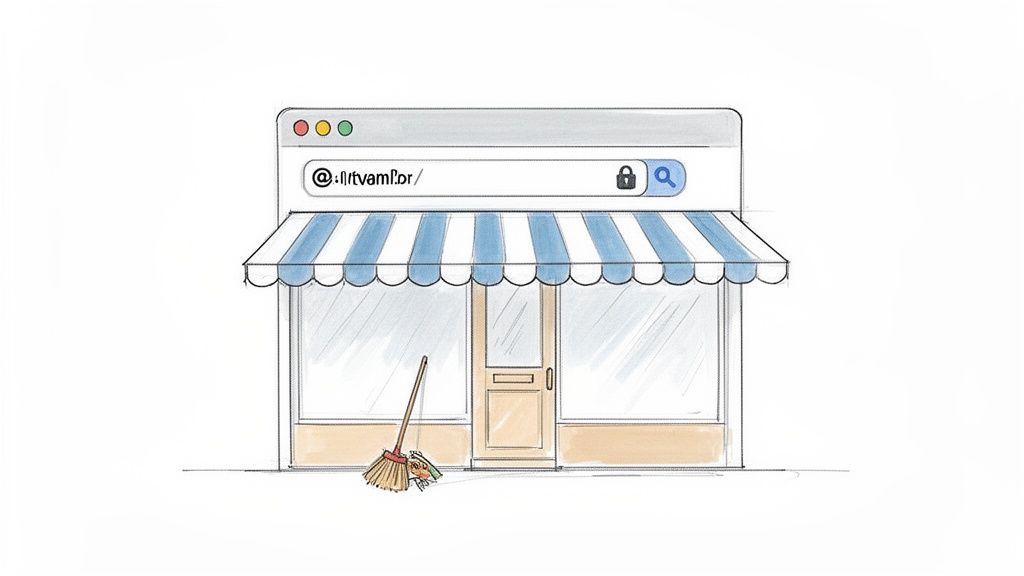
Picture your website as your prime high-street shop. You'd never dream of leaving the doors unlocked overnight, letting dust settle on the displays, or just ignoring that flickering light bulb in the corner, would you? Your digital storefront deserves the exact same level of care. For many UK businesses, it's their single most important asset.
Ignoring this is a surprisingly common and costly mistake. Proactive website maintenance isn't just a techie chore to be ticked off a list; it's a fundamental business function, every bit as crucial as managing your stock or delivering top-notch customer service. It’s the continuous work that keeps your site healthy, safe, and performing at its best.
Protecting Your Revenue and Reputation
This constant care has a direct and measurable impact on your bottom line. A slow, buggy, or offline website doesn't just annoy people—it sends them straight into the arms of your competitors. The data doesn't lie: studies show that nearly 40% of users will click away if a site takes longer than three seconds to load. Every person who leaves is a potential sale lost forever.
Worse still, a neglected website is an open invitation for security threats. Outdated software and plugins are the most common ways hackers get in. A breach can be catastrophic, leading to:
- Data Theft: Losing sensitive customer information can land you with crippling fines and do permanent damage to your brand's reputation.
- Costly Downtime: Every single minute your website is down is a minute you're not making sales or engaging with customers.
- Damaged Trust: A hacked website screams to your customers that you don't take their security seriously, shattering the trust you've worked so hard to build.
Building a Foundation for Growth
But it's not all about dodging disasters. Regular maintenance is what lays the groundwork for real, sustainable online growth. Search engines like Google actively reward websites that are fast, secure, and regularly updated with higher rankings. That means more organic traffic, better visibility, and more chances to connect with your perfect audience.
Investing in professional care isn’t just another expense on the spreadsheet. It's an insurance policy for your business's future and the fuel for its growth. It makes sure your digital shop is always open, welcoming, and ready to do business.
Ultimately, teaming up with a provider for website maintenance services UK lets you get back to what you do best: running your business. You can operate with the peace of mind that comes from knowing your digital presence is being looked after by experts. You can explore the benefits of professionally managed website services and see how they turn your website from a potential headache into a powerful, revenue-generating asset.
What's Actually on a Website Maintenance Checklist?
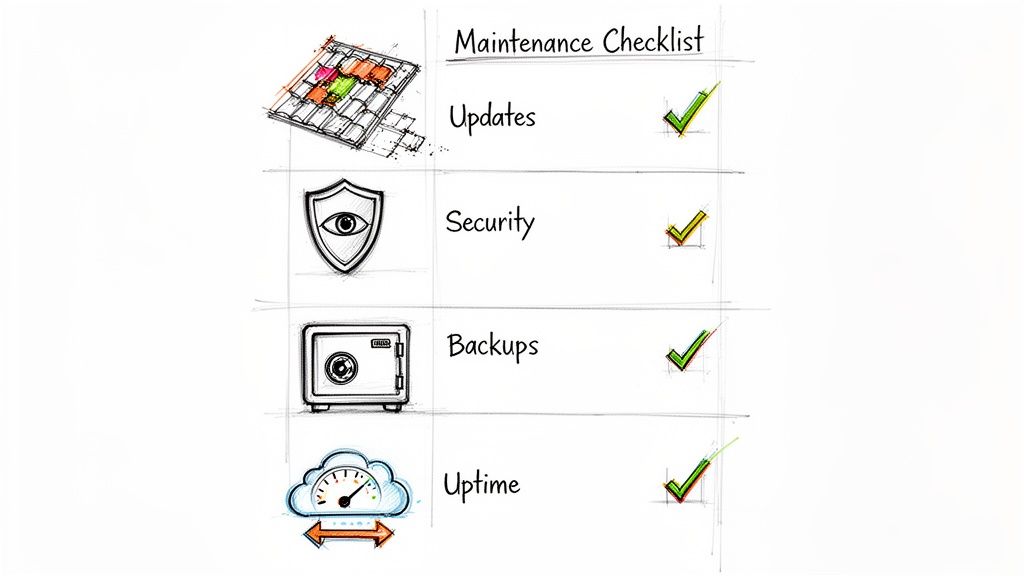
So, when you sign up for a website maintenance service, what are you actually getting for your money? It's not just a vague promise to "keep an eye on things." A proper plan is a structured list of critical jobs, each one playing a key part in keeping your digital shopfront healthy, secure, and open for business.
Think of it like getting your car MOT'd and serviced. You don't just drive it until the engine seizes; you get a professional to check the oil, test the brakes, and make sure the tyres are safe. This proactive approach stops small issues from becoming expensive disasters, and the same logic applies directly to your website.
Let's pull back the curtain on the core tasks of a quality maintenance plan. This way, you'll see exactly where your investment goes and why every single item on that list is vital for your UK business.
H3: Core Software and Plugin Updates
Your website is built on a software foundation – think WordPress, Joomla, or Drupal – and often has extra bits of code called plugins or modules to add features. These aren't "set and forget" components. Developers are constantly releasing updates to patch security flaws, fix annoying bugs, and improve how fast the software runs.
Putting off these updates is like leaving your front door unlocked. Hackers actively hunt for websites running old software because known vulnerabilities are the easiest way in. In fact, a shocking 30% of hacked websites are breached because of an outdated plugin or theme.
A good maintenance service takes this worry off your plate by:
- Testing updates in a safe staging area first to make sure they don't crash your live site.
- Applying security patches the moment they're released to close any known gaps.
- Checking for compatibility issues between your core system and all the plugins you use.
H3: Proactive Security Monitoring
While updates close known security holes, proactive monitoring is like having a 24/7 security guard patrolling your website. They're not just waiting for the alarm to go off; they're actively looking for suspicious characters trying to get in.
This digital shield usually involves regular malware scans, managing a strong firewall, and watching for dodgy login attempts. If a threat is spotted, your provider gets an instant alert and can step in to block the attack and secure your site – often before you even knew there was a problem.
A great maintenance plan doesn't just react to problems—it prevents them. Proactive security monitoring is the difference between a minor, averted threat and a full-blown business catastrophe.
H3: Regular and Reliable Backups
Let's say the worst happens. A determined hacker gets through, a server fails, or someone on your team accidentally deletes a critical page. Backups are your ultimate get-out-of-jail-free card. They are a complete copy of all your website's files and its database, stored safely somewhere else entirely.
It's the digital equivalent of a fireproof safe. Without backups, a major disaster could wipe out years of your hard work in an instant. A professional service ensures you have:
- Automated, regular backups (usually daily) so you always have a fresh copy to restore from.
- Off-site storage, meaning your backups are kept in a different location to your live site for total peace of mind.
- A quick and easy restoration process, so your provider can get you back online with minimal disruption.
H3: Uptime and Performance Tuning
A website that's offline or painfully slow is losing you money. It’s invisible to customers and a red flag for search engines. Uptime monitoring is a simple but crucial service that constantly checks if your site is accessible. If it goes down, even for a minute, your provider is notified immediately and starts working to fix it.
But just being online isn't enough; your site needs to be fast. Slow-loading pages are a huge reason why people give up and leave. Performance tuning is the ongoing process of optimising your site to make it as nippy as possible. This often includes:
- Image Compression: Shrinking image file sizes so they load quickly without looking pixelated.
- Database Optimisation: Having a regular clear-out of your site's database to keep it running efficiently.
- Implementing Caching: Storing static parts of your site so they load instantly for repeat visitors.
For platforms like WordPress, keeping things fast is a continuous job. If you want to get a better handle on what a well-oiled website needs, learning more about professional WordPress hosting and management can show you how all these pieces fit together. Ultimately, a speedy, well-tuned site doesn't just keep visitors happy – Google rewards it with better search rankings, which directly helps your business grow.
A Quick Summary of Essential Tasks
To bring it all together, here’s a simple breakdown of the most important jobs your maintenance provider should be handling.
Essential Website Maintenance Tasks at a Glance
| Maintenance Task | What It Does | Why It Matters for Your Business |
|---|---|---|
| Software & Plugin Updates | Regularly updates your website’s core system (e.g., WordPress) and all installed plugins to the latest versions. | Patches security holes, fixes bugs, and improves site speed. Prevents over 30% of common hacks. |
| Security Monitoring | Actively scans for malware, monitors for suspicious login attempts, and manages a protective firewall. | Acts as a 24/7 guard, stopping attacks before they can damage your reputation or steal data. |
| Regular Backups | Creates and stores complete copies of your website's files and database in a secure, off-site location. | Your ultimate safety net. Allows for a quick recovery from hacks, server failures, or human error. |
| Uptime Monitoring | Constantly checks if your website is online and accessible to visitors from around the world. | Minimises downtime. Ensures you're not losing customers or sales because your site is offline. |
| Performance Tuning | Optimises images, databases, and code, and implements caching to make your website load as fast as possible. | A faster site leads to better user experience, lower bounce rates, and improved Google rankings. |
Each of these tasks is a vital cog in the machine that keeps your online presence running smoothly, safely, and effectively.
How Site Performance Drives UK E-commerce Sales
In the fiercely competitive world of UK e-commerce, your website's performance is far more than just a technical box to tick—it's a direct line to your revenue. Think of it like this: a slow-loading product page is the digital equivalent of a high-street shop with a jammed door and a queue snaking down the pavement. Frustrated shoppers won't wait; they'll simply go next door, which is only ever a click away.
This isn't a small problem. It's a major leak in your sales pipeline. Study after study has shown that even a one-second delay in page load time can cause a 7% nosedive in conversions. For a UK online store with a turnover of £100,000, that’s £7,000 vanishing into thin air, all because of a sluggish site. The link is undeniable: speed sells.
The Financial Cost of a Slow Website
The moment a potential customer lands on your site, an invisible stopwatch starts. They expect instant results. If they're greeted by a spinning wheel for more than a couple of seconds, their patience evaporates. In fact, research shows that 40% of shoppers will abandon a site if it takes longer than three seconds to load. Worse still, many of them will never come back.
This has a serious knock-on effect on your entire business:
- Lost Sales: Every shopping basket abandoned due to a slow page is a direct hit to your bottom line.
- Damaged Customer Loyalty: A poor first impression makes it highly unlikely that a visitor will ever buy from you again, costing you all their future business.
- Higher Bounce Rate: When visitors leave almost immediately, it signals to Google that your site isn't delivering a good experience, which can gradually damage your search rankings.
This is a particularly sharp pain point for WooCommerce stores, which often have to juggle complex product catalogues, multiple payment gateways, and heavy customer data. Every extra plugin or fancy feature, if not managed correctly, can add precious milliseconds to your load time. That's why professional performance tuning isn't a luxury; it's a necessity.
Why Google Rewards Fast and Secure Sites
At the end of the day, search engines like Google have one core mission: give users the best, most relevant results. A fast, secure, and dependable website is a massive signal of quality and trustworthiness. It's no surprise, then, that site speed is a confirmed ranking factor for both desktop and mobile searches.
A well-maintained website sends all the right signals to Google. Through services like advanced caching, image optimisation, and server-level tweaking, a professional maintenance partner ensures your site is lightning-fast. This doesn't just keep your human visitors happy; it makes your site far more appealing to the search engine crawlers that decide where you rank.
In e-commerce, speed is a feature, and security is the foundation of trust. Neglecting either is like trying to build a retail empire on shaky ground. Professional maintenance solidifies that foundation, allowing you to build customer confidence and drive growth.
Security is just as critical. A site with a valid SSL certificate (that little padlock in the browser bar) that is constantly scanned for malware is seen as a safe haven for users. This is non-negotiable for e-commerce, where people are trusting you with their payment details. A security breach doesn’t just cost you in fines and fixes; it can shatter your brand's reputation overnight.
Building Trust and Maximising Sales
The UK e-commerce scene is a powerhouse, built on the back of dependable platforms like WooCommerce and WordPress. Its staggering growth only highlights the need for managed website maintenance services uk. With projected sales set to rocket to £285.60 billion by the end of 2025—making up over 30% of the entire UK retail market—the stakes have never been higher. This makes it all the more crucial to avoid common pitfalls, like the outdated plugins responsible for around 30% of all hacked websites. You can discover more insights about the UK e-commerce boom and its reliance on solid site management here.
Ultimately, every piece of the technical maintenance puzzle—from security patches to performance tuning—is an investment in customer trust. When a shopper's journey from browsing a product to hitting 'buy now' is fast, smooth, and secure, their confidence in your brand skyrockets. That confidence translates directly into higher conversion rates, more repeat business, and a much healthier bottom line. Professional maintenance isn't just about fixing things when they break; it's a powerful strategy for driving real e-commerce success.
Choosing the Right UK Website Maintenance Plan
Trying to find the right website maintenance plan can feel a lot like walking into a car showroom. You’ve got the basic models that will get you from A to B, the high-performance sports cars, and just about everything in between. The secret is to look past the price tag and find a plan that’s a perfect match for your business's engine.
After all, a small local blog has completely different needs than a busy WooCommerce store processing hundreds of sales a day. Pick the wrong plan, and you’re either paying for features you’ll never use or—even worse—leaving your site critically exposed when you need support the most.
Let's break down the typical service tiers you'll come across and give you a practical checklist to help you ask the right questions. The goal is to arm you with the confidence to choose a partner that delivers real value and, most importantly, complete peace of mind.
Understanding the Different Service Tiers
Most UK providers package their maintenance services into different levels, often called something like Starter, Professional, and Premium. The names might vary, but the idea is the same: the level of support and technical TLC scales up with your website's complexity and traffic.
This flowchart shows the simple but powerful link between your site's speed and your bottom line.
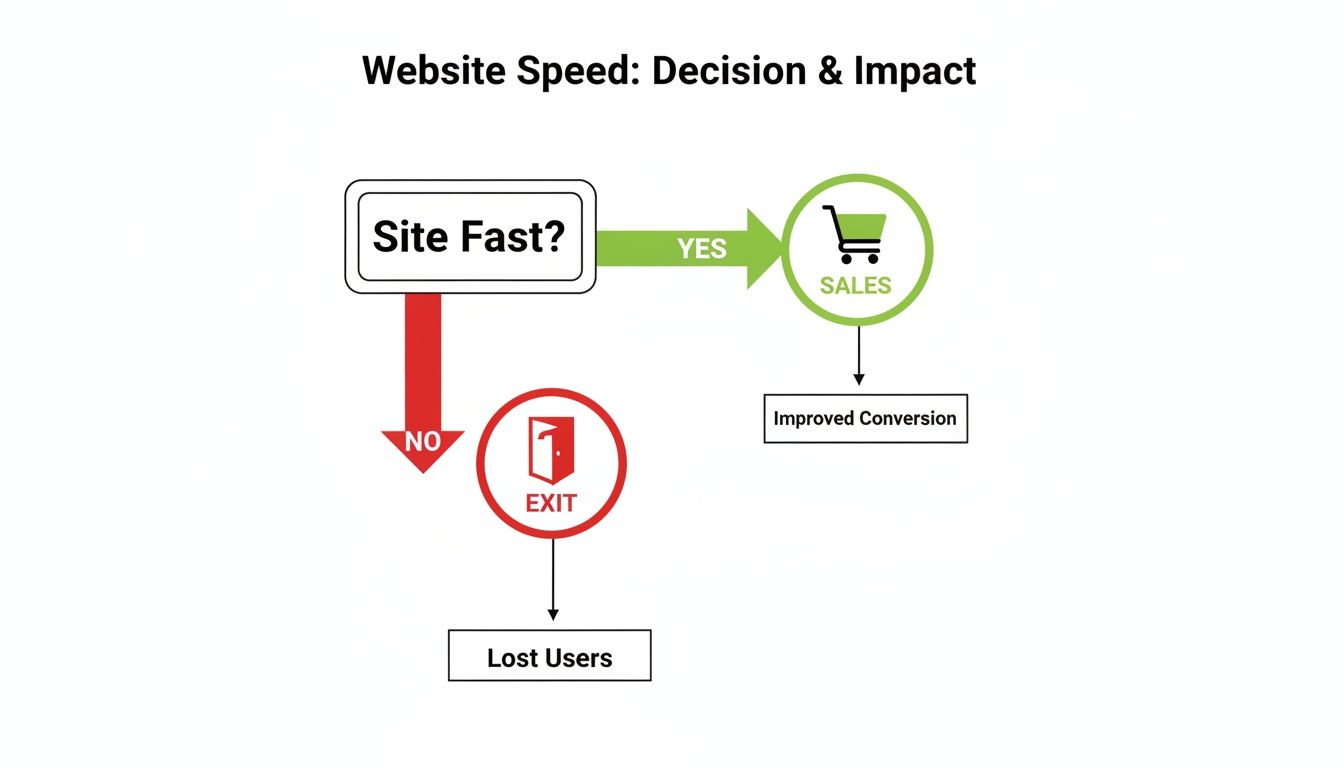
It’s clear that a fast, responsive website directly fuels commercial success, while a slow one actively drives potential customers away. A good maintenance plan is what keeps your site in that fast lane.
Here’s a quick look at what you can generally expect from each level:
Starter Plans: These are built for simple "brochure" websites, personal blogs, or small businesses with a low-key online presence. They cover the absolute essentials, like core software updates, monthly backups, and basic security scans. Support is usually limited to email.
Professional Plans: This is often the sweet spot for most growing small to medium-sized businesses (SMBs) and smaller e-commerce stores. You’ll get everything in the starter plan plus more frequent backups (often daily), stronger security monitoring, performance tuning, and access to priority support.
Premium or Agency Plans: These are tailored for high-traffic e-commerce sites, businesses juggling multiple websites, or digital agencies managing sites for their clients. They offer the highest level of service, including real-time backups, advanced firewalls, dedicated support time for small development jobs, and proactive performance optimisation.
Choosing a plan is about anticipating your future needs, not just reacting to your current situation. If you're planning a big marketing campaign or launching a new product line, investing in a plan that can handle a sudden traffic spike is a very smart move.
Comparing UK Website Maintenance Service Tiers
To help you visualise where your business might fit, here’s a breakdown of what you typically find in different maintenance plans. Think about your website’s current role and where you want it to be in the next year.
| Feature | Starter Plan (e.g., for Bloggers/Brochure Sites) | Professional Plan (e.g., for SMBs/Growing E-commerce) | Premium/Agency Plan (e.g., for High-Traffic Stores/Multi-Site) |
|---|---|---|---|
| Core & Plugin Updates | Monthly checks | Weekly or bi-weekly checks | Proactive, daily checks |
| Backups | Monthly or weekly, stored off-site | Daily, stored off-site with easy restore options | Real-time or multiple daily backups, often with a staging environment for testing restores |
| Security | Basic malware scans | Enhanced security monitoring & a Web Application Firewall (WAF) | Advanced WAF, proactive threat detection, and free malware removal |
| Performance | Basic monitoring | Regular performance tuning & caching optimisation | Proactive speed optimisation, image compression, and Content Delivery Network (CDN) integration |
| Uptime Monitoring | Basic (e.g., every 30 mins) | Frequent (e.g., every 5 mins) with instant alerts | Constant (e.g., every 1 min) with an uptime guarantee |
| Support | Email support, standard business hours | Priority email/ticket support with faster response times | Dedicated account manager, phone support, and 24/7 emergency availability |
| Reporting | Basic monthly report | Detailed monthly report with analytics and insights | Customised, in-depth monthly or quarterly reports with strategic recommendations |
This table highlights how services scale up. A starter plan provides a basic safety net, while professional and premium tiers offer a more proactive, hands-on partnership to protect and grow your online presence.
Your Essential Buyer's Checklist
When you're comparing providers, it’s vital to look beyond the shiny feature list on their pricing page. The real quality of a service is in the details. Before you sign anything, make sure you get straight answers to these critical questions.
1. Where Are Your Servers Located?
For a UK business with UK customers, having your website hosted on UK servers is a huge advantage. It can mean faster load times for your local audience and may even give your local SEO a little boost.
2. What Is Your Support Availability and Response Time?
Website problems don't keep a 9-to-5 schedule. Does the provider offer 24/7 support? What are their guaranteed response times for a critical "site down" emergency versus a minor question? Getting a clear picture of their Service Level Agreement (SLA) is non-negotiable.
3. How Frequently Are Backups Taken and How Are They Stored?
Daily backups are the bare minimum for any active business website. Ask how many days of backups they keep and confirm that they are stored "off-site"—that is, in a completely separate physical location from the server hosting your live website. This is a crucial part of any real disaster recovery plan.
4. What Specific Security Measures Are Included?
"Security monitoring" is a vague term that can mean a lot of different things. Ask for specifics. Do they provide a Web Application Firewall (WAF)? Do they perform regular malware scans? Crucially, do they offer free malware removal if your site gets compromised?
5. Are There Any Hidden Costs?
Get absolute clarity on what's included. For example, if your site gets hacked, is the cleanup covered by your plan, or will that be an extra fee? Does the plan include an SSL certificate, or is that another cost? Honesty and transparency are the hallmarks of a partner you can trust.
Finding the right plan is all about matching a provider’s expertise to your business goals. For a closer look at how plans are structured to support businesses at every stage, you can explore detailed breakdowns of UK website maintenance packages to see how these elements come together in the real world. Armed with this knowledge, you can confidently choose a partner to protect and grow your most important digital asset.
The Hidden Costs of Neglecting Your Website
It’s tempting to treat your website as a "set it and forget it" project. You’ve launched it, it looks great, and now it’s time to focus on the business, right? Unfortunately, this is a dangerous gamble. While it feels like you're saving money, neglect is a silent threat that builds up over time, often leading to a sudden and catastrophic failure.
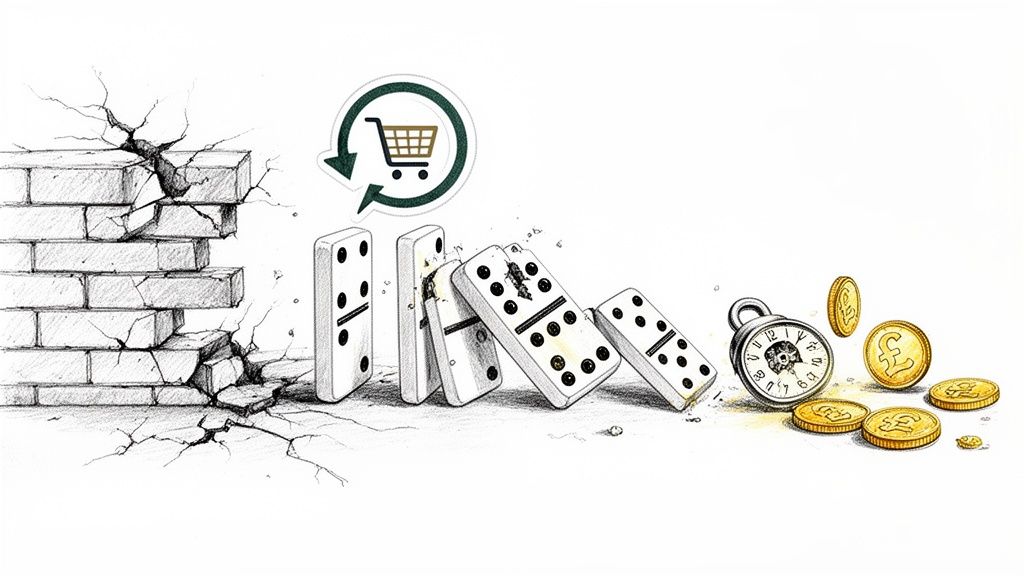
The real cost of doing nothing isn't just a future repair bill; it's a domino effect that can seriously damage your business.
Think about it like this: a single, seemingly harmless plugin update is missed. At first, you notice nothing. But weeks or months down the line, a hacker exploits that exact vulnerability—a digital back door you never knew was unlocked. This isn't some far-fetched scenario; over 40% of all cyber-attacks target small businesses, precisely because their digital defences are often out of date.
When it happens, the aftermath is a frantic scramble. Your site is offline, riddled with errors, or worse, has been completely defaced. And that's when the costs start piling up.
The Emergency Scramble and Financial Fallout
The first hit is direct and painful: lost sales. Every minute your website is down is another minute your digital shop is closed. Customers can’t buy, potential clients can’t get in touch, and your revenue stream just stops dead.
Then comes the emergency repair bill. You’re not calmly getting quotes from trusted partners. You’re desperately calling expensive freelance developers who charge a premium for last-minute, high-stress fixes. A problem that could have been prevented with a simple, routine update has now spiralled into an urgent, four-figure crisis.
But those visible expenses are just the tip of the iceberg. The hidden costs are what truly hurt:
- Lost Data: A security breach could mean your customer database is stolen or your entire site is wiped. Without recent, reliable backups, you could lose years of work in an instant.
- Damaged Brand Reputation: A hacked or broken website shatters customer trust. Visitors will see you as unprofessional or, even worse, careless with their data. Rebuilding that confidence takes a very long time.
- Plummeting SEO Rankings: Google notices when a site is slow, insecure, or frequently offline. Your hard-earned search rankings can nosedive, making it much harder for new customers to find you, even after you’ve fixed the problem.
The Domino Effect on Performance and Trust
Neglect doesn’t just invite hackers; it slowly degrades your user experience, day by day. Over time, your site gets sluggish as unoptimised images and bloated code pile up. Links break, contact forms silently fail, and the mobile experience becomes clunky and frustrating.
This gradual decay has a huge impact. The UK web performance market is forecast to reach USD 697.8 million by 2030, showing just how seriously businesses are taking speed and stability. When you consider that 40% of users will abandon a page if it takes more than three seconds to load, it’s easy to see why. You can discover more research about the UK web performance market and how it affects business success.
Proactive website maintenance is not an expense; it is an essential insurance policy for your business continuity. It shifts the focus from panicked, expensive repairs to controlled, predictable care that protects your revenue and reputation.
By investing in professional website maintenance services UK, you aren't just paying for technical tasks. You’re buying peace of mind and safeguarding your most valuable digital asset. You’re ensuring your digital doors are always open, your customers feel safe, and your business is protected from the entirely preventable domino effect of neglect.
Answering Your UK Website Maintenance Questions
Thinking about getting professional help for your website? It’s a smart move, but it naturally brings up a lot of questions. If you’re a UK business owner, you're probably weighing up the costs, the benefits, and what it all actually involves day-to-day.
This section tackles the most common questions we hear. We’ll give you clear, straightforward answers to help you feel confident you're making the right decision for your business.
How Much Should I Expect to Pay for Website Maintenance in the UK?
This is usually the first question on everyone's mind, and the honest answer is: it depends. The price tag for website maintenance services uk really comes down to how complex your site is and what your business needs from it. Think of it like a business insurance policy—the cover you need depends on what you’re protecting.
For a simple brochure website or a personal blog, a basic plan covering the essentials like updates and security could start from around £50 to £100 per month.
But if you’re a growing business or have a small e-commerce store, you'll need something more robust. Professional-tier plans typically run from £150 to £350 per month, and for that, you'd expect to get daily backups, more advanced security, and performance tuning. A busy WooCommerce store or a business that needs priority support will, of course, sit at the higher end of the scale.
It's helpful to reframe the cost. Don't see it as just another expense. See it as an investment measured against the potential cost of a single hour of downtime or a damaging security breach. A good plan gives you predictable costs and stops you from having to make an expensive emergency call-out later.
Can I Just Handle Website Maintenance Myself?
You can, technically. But you have to be brutally honest with yourself about the time, technical skill, and sheer consistency it takes. Going the DIY route means you are the one responsible for running every update, checking for plugin conflicts, scanning for malware, and making sure your backups are actually working.
It’s a path that comes with some serious risks:
- Time Commitment: Every hour you spend trying to fix a technical glitch is an hour you’re not spending on sales, marketing, or looking after your customers.
- Technical Knowledge: Do you know how to safely restore a backup if a dodgy update breaks your site? Can you spot and clean up a malware infection?
- Consistency is Key: Maintenance isn't a job you do once and forget. To be effective, it has to be done regularly, without fail.
Handing it over to a professional service simply frees you up to focus on your business. You get the peace of mind that an expert is handling all the technical heavy lifting.
How Difficult Is It to Switch Maintenance Providers?
The idea of moving your website can feel a bit daunting, I get it. But with a good provider, the whole process is surprisingly smooth. A professional maintenance partner will manage the entire migration for you, making sure the switch is seamless and, most importantly, involves zero downtime for your visitors.
It’s all designed to be hassle-free. The process usually starts with a chat to understand your current setup. Then, their technical team securely copies your site to their servers and runs it through its paces in a safe staging area. Only when everyone is happy do they switch the live site over. It's an expert-led process that makes switching to a better service a safe and simple step.
What Happens if My Website Goes Down?
This is where a professional maintenance plan really earns its keep. If your website ever goes offline, a good provider’s monitoring system will alert their technical team almost instantly—often before you or your customers even realise there’s a problem.
Their first priority is to figure out what's wrong and get you back online, fast. With recent, reliable backups always ready to go, they have an immediate safety net. Instead of you frantically searching for a solution under pressure, a dedicated team is already actioning a recovery plan. This 24/7 support is what keeps your business running, turning a potential disaster into a minor hiccup that gets sorted quickly.
Your website is your most important digital asset; keeping it fast, secure, and reliable is essential for growth. Vivihosting provides complete, managed website care specifically for UK businesses, handling all the technical details so you can focus on what you do best. Explore our managed hosting and maintenance plans today. Learn more at https://vivihosting.com.